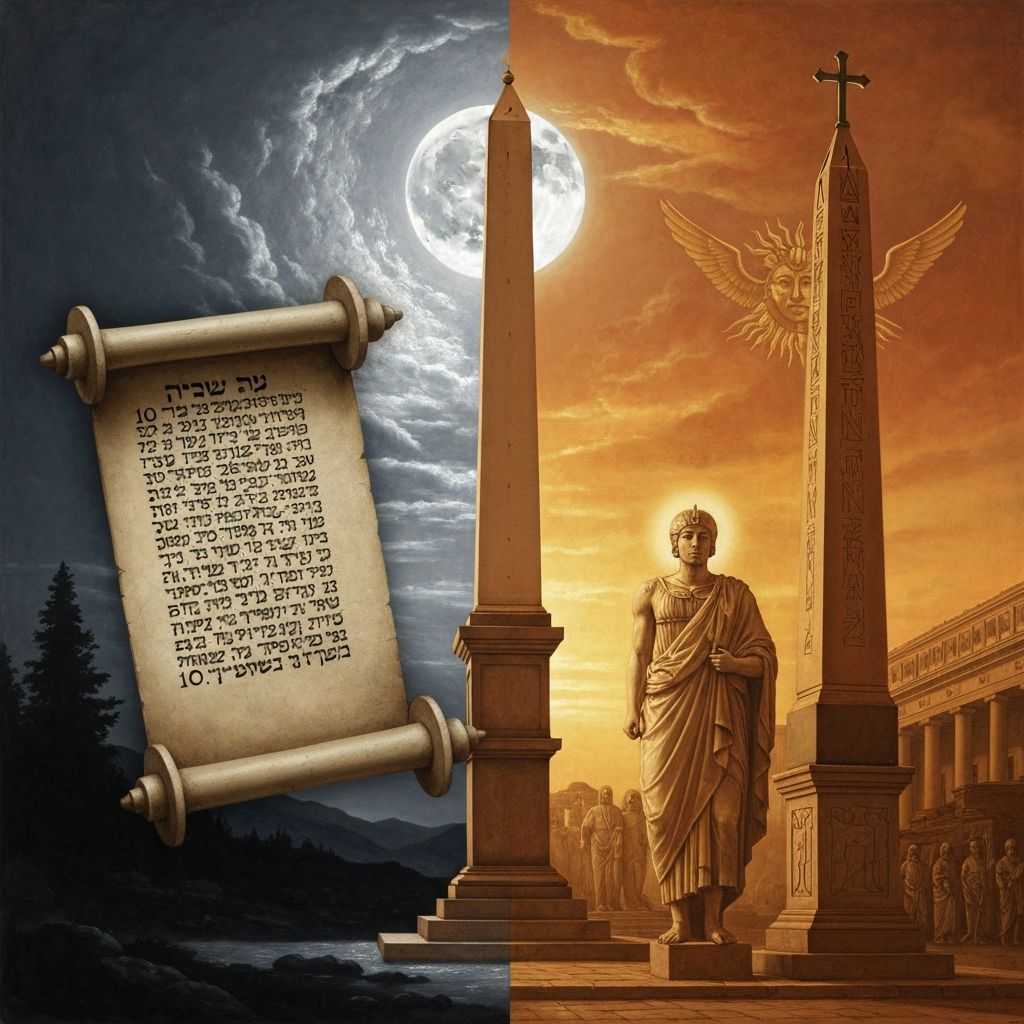
Daniel's 70 Weeks: The Messianic Prophecy Fulfilled
Unveiling the Precise Fulfillment of Messianic Prophecy and the Magnificent Typologies That Point to Christ
2025-01-05

Introduction: A Prophecy So Precise It Defies Human Explanation
In the annals of biblical prophecy, no single prediction stands as more remarkable, more precise, or more perfectly fulfilled than Daniel's prophecy of the seventy weeks. This extraordinary vision, given to the prophet Daniel in the sixth century before Christ, provides a mathematical timeline so accurate that it pinpoints the exact year of the Messiah's baptism, the precise moment of His crucifixion, and the specific time when the gospel would extend beyond the Jewish nation to embrace all humanity.
What makes this prophecy truly astounding is not merely its precision, but the intricate web of typologies, symbols, and prophetic fulfillments that surround it. From the sacrifice of Isaac on Mount Moriah to the elaborate sanctuary services that prefigured Christ's heavenly ministry, the entire Old Testament points with laser-like focus toward the events prophesied in Daniel's seventy weeks.
This is not merely an academic exercise in biblical chronology. This is the revelation of God's master plan for human redemption, executed with such mathematical precision that it leaves no room for coincidence or human manipulation. When Jesus declared, "And I, if I be lifted up from the earth, will draw all men unto me" (John 12:32), He was speaking of an event that had been prophesied to the very year, the very season, and even the very day of the week centuries before His birth.
The implications of this prophecy extend far beyond the first century. The same divine timeline that predicted Christ's first advent with such accuracy also reveals the timing of His final work in the heavenly sanctuary, providing us with unmistakable evidence that we are living in the closing moments of earth's history.
As we embark on this journey through one of Scripture's most magnificent prophecies, we will discover that every detail of Christ's life, death, and ministry was not only foretold but was prefigured through an elaborate system of types and shadows that permeate the entire Old Testament. From Abraham's willingness to sacrifice his only son to the intricate ceremonies of the Day of Atonement, every element points to the same glorious truth: God had a plan, and that plan was executed with perfect timing.
The prophet Daniel received this vision during one of the darkest periods in Jewish history. Jerusalem lay in ruins, the temple was destroyed, and God's people were scattered in Babylonian captivity. Yet in this moment of apparent defeat, God revealed a prophecy that would demonstrate His absolute sovereignty over human history and His unwavering commitment to the redemption of mankind.
What we are about to examine is not merely a prophecy—it is a divine masterpiece that reveals the heart of God and the precision of His eternal plan. Every calculation, every fulfillment, and every typological connection serves to demonstrate that the God of the Bible is indeed the God of history, and that His word can be trusted with absolute confidence.
Chapter 1: The Foundation - Understanding the Day-Year Principle
The Biblical Foundation of the Day-Year Principle
The day-year principle is not a human invention or an arbitrary interpretive device. Rather, it is a divinely established method of prophetic interpretation that God Himself has embedded within the pages of Scripture. The principle is elegantly simple: in symbolic prophecy, particularly in the apocalyptic books of Daniel and Revelation, a prophetic day represents a literal year.
This principle finds its clearest expression in two foundational passages of Scripture. The first is found in Numbers 14:34, where God declares to the rebellious Israelites: "According to the number of the days in which you spied out the land, forty days, for each day you shall bear your guilt one year, namely forty years, and you shall know My rejection." Here we see God Himself establishing the principle that one day can represent one year in His prophetic timetable.
The second foundational passage appears in Ezekiel 4:5-6, where God commands the prophet: "For I have laid on you the years of their iniquity, according to the number of the days, three hundred and ninety days; so you shall bear the iniquity of the house of Israel. And when you have completed them, lie again on your right side; then you shall bear the iniquity of the house of Judah forty days. I have laid on you a day for each year."
These passages are not isolated instances but represent a consistent divine pattern. In both cases, God explicitly states that He is using days to represent years in His prophetic communications. This establishes beyond question that the day-year principle has divine sanction and biblical precedent.
The Logical Necessity of the Day-Year Principle
Beyond its biblical foundation, the day-year principle proves to be logically necessary when we examine the scope and nature of the prophecies in Daniel and Revelation. Consider, for instance, the prophecy we are about to examine: Daniel's seventy weeks. If we were to interpret these seventy weeks as literal weeks of seven days each, we would have a total of only 490 days, or approximately one year and four months.
Such a brief timeframe could not possibly encompass the events described in the prophecy: the rebuilding of Jerusalem, the coming of the Messiah, His being "cut off," and the destruction of the city and sanctuary. These events clearly require a much longer timeframe, which the day-year principle provides by extending the seventy weeks to 490 years.
Similarly, other time prophecies in Daniel and Revelation speak of periods such as "a time, times, and half a time" (Daniel 7:25, Revelation 12:14), "forty-two months" (Revelation 11:2, 13:5), and "1,260 days" (Revelation 11:3, 12:6). When interpreted literally, these periods are far too brief to accommodate the historical events they describe. However, when the day-year principle is applied, these prophecies align perfectly with documented historical periods.
Historical Validation of the Day-Year Principle
The day-year principle has been validated not only by its biblical foundation and logical necessity but also by its remarkable historical accuracy. When applied to the prophecies of Daniel and Revelation, this principle has consistently yielded precise fulfillments that align perfectly with documented historical events.
For example, the prophecy of the 1,260 days (interpreted as 1,260 years using the day-year principle) has been widely recognized as pointing to the period of papal supremacy from 538 AD to 1798 AD, when the papal system exercised unprecedented political and religious authority over Europe. This period ended precisely when Napoleon's general, Berthier, took the Pope captive in 1798, inflicting what Revelation 13:3 describes as a "deadly wound" to the papal system.
The accuracy of these fulfillments provides compelling evidence that the day-year principle is not only biblically sound but also historically validated. When God's prophetic word is interpreted according to the principles He Himself has established, it proves to be remarkably precise and reliable.
The Theological Significance of the Day-Year Principle
The day-year principle carries profound theological significance that extends beyond mere chronological calculation. It demonstrates that God operates on a different temporal scale than human beings, reflecting the biblical truth that "one day is with the Lord as a thousand years, and a thousand years as one day" (2 Peter 3:8).
This principle also reveals God's patience and long-suffering toward humanity. Rather than executing His judgments immediately, God often allows extended periods of time for repentance and reformation. The long prophetic periods revealed through the day-year principle demonstrate that God's mercy endures for generations, even as His justice remains certain.
Furthermore, the day-year principle underscores the cosmic scope of the great controversy between good and evil. The prophetic periods revealed in Daniel and Revelation span centuries and millennia, indicating that the conflict between Christ and Satan is not a brief skirmish but an extended campaign that encompasses the entire history of human civilization.
Application to Daniel's Seventy Weeks
With the day-year principle firmly established, we can now approach Daniel's seventy weeks prophecy with confidence. The seventy weeks mentioned in Daniel 9:24 represent seventy prophetic weeks of seven days each, totaling 490 prophetic days. When the day-year principle is applied, these 490 days become 490 literal years.
This transformation from days to years is not arbitrary but follows the same divine pattern established in Numbers and Ezekiel. Just as God used days to represent years in those earlier prophecies, so He uses the same principle in Daniel's vision. The result is a prophetic timeline that spans nearly five centuries, providing ample time for all the events described in the prophecy to unfold with perfect precision.
The seventy weeks are further divided into three distinct periods: seven weeks (49 years), sixty-two weeks (434 years), and one week (7 years). This division is not accidental but reflects the different phases of God's plan for His people and the world. Each period has its own specific fulfillments and significance, contributing to the overall prophetic narrative.
As we will see in the following chapters, this 490-year timeline, beginning with the decree to restore and rebuild Jerusalem in 457 BC, unfolds with mathematical precision to reveal the exact timing of the Messiah's ministry, His sacrificial death, and the extension of the gospel to the Gentile world. The accuracy of these fulfillments provides irrefutable evidence that the God of the Bible is indeed the God of history, and that His prophetic word can be trusted completely.
The day-year principle thus serves as more than just an interpretive tool—it becomes a window into the mind and heart of God, revealing His meticulous planning, His perfect timing, and His unwavering commitment to the redemption of humanity. As we apply this principle to Daniel's seventy weeks prophecy, we will discover that every year, every event, and every fulfillment has been orchestrated by divine wisdom to accomplish God's eternal purposes.
Chapter 2: The Prophetic Timeline - From Artaxerxes to the Messiah
The Starting Point: The Decree to Restore and Build Jerusalem
Daniel 9:25 provides the crucial starting point for the entire prophetic timeline: "Know therefore and understand, that from the going forth of the commandment to restore and to build Jerusalem unto the Messiah the Prince shall be seven weeks, and threescore and two weeks: the street shall be built again, and the wall, even in troublous times."
The phrase "the going forth of the commandment to restore and to build Jerusalem" refers to a specific historical decree that would authorize not merely the rebuilding of the temple, but the complete restoration of Jerusalem as a functioning city with its streets, walls, and governmental autonomy. This distinction is crucial, as several decrees were issued regarding the Jewish return from Babylonian captivity, but only one fully meets the criteria specified in Daniel's prophecy.
The decree that fulfills Daniel's prophecy was issued by Artaxerxes I, king of Persia, in the seventh year of his reign, which corresponds to 457 BC according to established historical chronology. This decree is recorded in Ezra 7:12-26, where Artaxerxes grants Ezra sweeping authority to restore not only the temple services but the entire civil and religious infrastructure of Jerusalem.
The significance of this decree cannot be overstated. Unlike previous decrees that focused primarily on temple reconstruction, Artaxerxes' decree in 457 BC authorized the complete restoration of Jerusalem as an autonomous Jewish state. Ezra was given authority to appoint magistrates and judges, to establish courts of law, and to enforce Jewish civil and religious law throughout the province. This decree truly represented "the going forth of the commandment to restore and to build Jerusalem" in its fullest sense.
The historical accuracy of this date has been confirmed through multiple lines of evidence. Ancient Persian records, astronomical calculations, and cross-references with other historical events all converge to establish 457 BC as the year when Artaxerxes issued his comprehensive decree for Jerusalem's restoration.
The Mathematical Precision of the Prophecy
From this starting point of 457 BC, Daniel's prophecy unfolds with mathematical precision. The seventy weeks are divided into three distinct periods, each with its own specific fulfillment:
Seven weeks (49 years): 457 BC to 408 BC
This first period covers the time required to rebuild Jerusalem's streets and walls "in troublous times." Historical records confirm that the restoration of Jerusalem was indeed completed during this period, despite significant opposition from surrounding peoples. The work was accomplished under the leadership of Ezra and later Nehemiah, exactly as the prophecy predicted.
Sixty-two weeks (434 years): 408 BC to 27 AD
This lengthy middle period spans from the completion of Jerusalem's restoration to the appearance of "Messiah the Prince." The prophecy states that after seven weeks plus sixty-two weeks (totaling sixty-nine weeks or 483 years), the Messiah would appear. Calculating 483 years from 457 BC brings us to 27 AD, the year when Jesus was baptized by John the Baptist and began His public ministry.
One week (7 years): 27 AD to 34 AD
The final week of the prophecy covers the period of the Messiah's ministry and the immediate aftermath. This period is further divided into two halves, with the Messiah being "cut off" in the midst of the week, exactly 3.5 years into His ministry.
The Anointing of the Messiah: 27 AD
The precision of this prophetic timeline becomes evident when we examine the events of 27 AD. According to Luke 3:1, John the Baptist began his ministry "in the fifteenth year of the reign of Tiberius Caesar." Historical records establish that Tiberius began his sole reign in 14 AD, making his fifteenth year 28 AD. However, Luke's Gospel also indicates that Jesus was baptized in the autumn of the previous year, which would be 27 AD.
This baptism represents the fulfillment of the prophecy's reference to "Messiah the Prince." The word "Messiah" means "anointed one," and it was at His baptism that Jesus was anointed by the Holy Spirit for His messianic ministry. Luke 3:21-22 records: "Now when all the people were baptized, it came to pass, that Jesus also being baptized, and praying, the heaven was opened, And the Holy Ghost descended in a bodily shape like a dove upon him, and a voice came from heaven, which said, Thou art my beloved Son; in thee I am well pleased."
The timing of this event, exactly 483 years after the decree of Artaxerxes, demonstrates the supernatural precision of Daniel's prophecy. This was not a coincidence or a fortunate guess, but the fulfillment of a divine timetable that had been established centuries earlier.
The Messiah Cut Off: 31 AD
Daniel 9:26-27 provides additional chronological details about the final week of the prophecy: "And after threescore and two weeks shall Messiah be cut off, but not for himself... And he shall confirm the covenant with many for one week: and in the midst of the week he shall cause the sacrifice and the oblation to cease."
The phrase "in the midst of the week" indicates that the Messiah would be "cut off" (killed) exactly halfway through the final seven-year period. Since the seventieth week began in 27 AD, the midpoint would fall in 31 AD, precisely 3.5 years after Jesus began His ministry.
This timing aligns perfectly with the Gospel accounts of Jesus' ministry. While the exact duration of Jesus' public ministry has been debated, the weight of biblical evidence supports a ministry of approximately 3.5 years, from His baptism in autumn 27 AD to His crucifixion in spring 31 AD.
The phrase "he shall cause the sacrifice and the oblation to cease" refers to the end of the Old Testament sacrificial system. When Jesus died on the cross, the veil of the temple was torn from top to bottom (Matthew 27:51), symbolizing that the earthly sanctuary services had fulfilled their purpose. The sacrificial system that had pointed forward to Christ's sacrifice was no longer needed, as the reality had come.
The Covenant Confirmed: 27-34 AD
Daniel 9:27 states that "he shall confirm the covenant with many for one week." This refers to Christ's work of confirming the covenant that God had made with Abraham and his descendants. During the seven-year period from 27 to 34 AD, the gospel was preached primarily to the Jewish people, giving them the first opportunity to accept their Messiah.
For the first 3.5 years (27-31 AD), Jesus Himself preached to the Jewish people. After His death and resurrection, the apostles continued this work for another 3.5 years (31-34 AD), focusing their evangelistic efforts on the Jewish nation. This period represents God's final appeal to His chosen people to accept the Messiah they had long awaited.
The Gospel to the Gentiles: 34 AD
The end of the seventy weeks in 34 AD marked a crucial transition in salvation history. Up to this point, the gospel had been preached primarily to the Jewish people, in fulfillment of Jesus' instruction to His disciples: "Go not into the way of the Gentiles, and into any city of the Samaritans enter ye not: But go rather to the lost sheep of the house of Israel" (Matthew 10:5-6).
However, the stoning of Stephen in 34 AD marked the end of the special probationary period that God had granted to the Jewish nation. Acts 7:54-60 records Stephen's martyrdom, which was followed by a great persecution that scattered the believers throughout the regions of Judea and Samaria (Acts 8:1).
This scattering led directly to the expansion of the gospel beyond the Jewish people. Philip preached to the Samaritans (Acts 8:5), and shortly afterward, Peter was directed by divine vision to preach to Cornelius, a Gentile centurion (Acts 10). This marked the beginning of the gospel's extension to all nations, exactly as prophesied.
The mathematical precision of this timeline is truly remarkable. From the decree of Artaxerxes in 457 BC to the stoning of Stephen in 34 AD represents exactly 490 years—the seventy weeks of Daniel's prophecy. Every major event falls precisely where the prophecy predicted it would occur.
The Prophetic Significance of Perfect Timing
The precision of Daniel's seventy weeks prophecy serves multiple purposes in God's plan. First, it provides irrefutable evidence of the divine inspiration of Scripture. No human being could have predicted these events with such mathematical accuracy centuries before they occurred. The fulfillment of this prophecy demonstrates that the Bible is indeed the word of God.
Second, the prophecy validates Jesus' claim to be the Messiah. The timing of His appearance, ministry, and death aligns perfectly with Daniel's predictions, providing objective evidence that Jesus is indeed the promised Savior. This was not a case of Jesus attempting to fulfill prophecy, but of prophecy being fulfilled in Him despite His having no control over the timing of the decree that started the prophetic countdown.
Third, the prophecy reveals God's perfect timing in the plan of salvation. Every event occurred at precisely the right moment in history to accomplish God's purposes. The Messiah came at the exact time prophesied, died at the precise moment predicted, and the gospel went to the Gentiles exactly when foretold.
This perfect timing continues to have relevance for our day. The same God who orchestrated the events of the seventy weeks with such precision is still in control of history today. The fulfillment of this prophecy provides confidence that God's remaining promises will also be fulfilled exactly as predicted.
As we will see in the following chapters, the seventy weeks prophecy is intimately connected with other prophetic timelines that extend to our own time. The same mathematical precision that marked the first advent of Christ also points to the timing of His final work in the heavenly sanctuary and His second advent. Understanding Daniel's seventy weeks thus provides a key to understanding our place in the stream of prophetic history.
Chapter 3: The Messiah's Suffering - Prophecies Fulfilled in Perfect Detail
Psalm 22: The Crucifixion Psalm
Perhaps no Old Testament passage describes the crucifixion with greater detail and accuracy than Psalm 22. Written by King David approximately 1,000 years before Christ's birth, this psalm provides a prophetic preview of the Messiah's suffering that is so precise it could serve as a medical description of crucifixion.
The psalm begins with the very words that Jesus would speak from the cross: "My God, my God, why hast thou forsaken me? why art thou so far from helping me, and from the words of my roaring?" (Psalm 22:1). Matthew 27:46 records that Jesus cried out these exact words during His crucifixion, fulfilling David's prophecy to the letter.
The physical details described in Psalm 22 align perfectly with the medical realities of crucifixion. Verse 14 states: "I am poured out like water, and all my bones are out of joint: my heart is like wax; it is melted in the midst of my bowels." This describes the physiological effects of crucifixion with remarkable accuracy. The stretching of the body on the cross would indeed cause the bones to separate at their joints, while the stress and trauma would cause the heart to fail.
Verse 15 continues: "My strength is dried up like a potsherd; and my tongue cleaveth to my jaws; and thou hast brought me into the dust of death." This describes the severe dehydration and thirst that accompanied crucifixion, which Jesus experienced when He cried out, "I thirst" (John 19:28).
Perhaps most remarkably, Psalm 22:16 prophesies: "For dogs have compassed me: the assembly of the wicked have inclosed me: they pierced my hands and my feet." This verse specifically predicts the piercing of the hands and feet, the distinctive feature of crucifixion. What makes this prophecy even more extraordinary is that crucifixion was not practiced by the Jews and had not yet been invented by the Romans when David wrote this psalm. Yet the prophecy accurately describes this method of execution that would be used against the Messiah.
The psalm also predicts the mockery that Jesus would endure: "All they that see me laugh me to scorn: they shoot out the lip, they shake the head, saying, He trusted on the LORD that he would deliver him: let him deliver him, seeing he delighted in him" (Psalm 22:7-8). This prophecy was fulfilled precisely as recorded in Matthew 27:39-43, where the religious leaders mocked Jesus with almost identical words.
Even the division of Christ's garments is prophesied in Psalm 22:18: "They part my garments among them, and cast lots upon my vesture." John 19:23-24 records the exact fulfillment of this prophecy, noting that the soldiers divided Jesus' garments among themselves and cast lots for His seamless robe.
Isaiah 53: The Suffering Servant
The fifty-third chapter of Isaiah provides perhaps the most comprehensive prophecy of the Messiah's suffering and its redemptive purpose. Written approximately 700 years before Christ's birth, this passage describes not only the physical aspects of the Messiah's suffering but also its spiritual significance.
Isaiah 53:3 prophesies that the Messiah would be "despised and rejected of men; a man of sorrows, and acquainted with grief: and we hid as it were our faces from him; he was despised, and we esteemed him not." This perfectly describes the rejection that Jesus experienced from His own people, culminating in their choice of Barabbas over Him and their cry for His crucifixion.
The substitutionary nature of the Messiah's suffering is clearly prophesied in verses 4-6: "Surely he hath borne our griefs, and carried our sorrows: yet we did esteem him stricken, smitten of God, and afflicted. But he was wounded for our transgressions, he was bruised for our iniquities: the chastisement of our peace was upon him; and with his stripes we are healed. All we like sheep have gone astray; we have turned every one to his own way; and the LORD hath laid on him the iniquity of us all."
This passage reveals that the Messiah's suffering was not for His own sins but for the sins of others. The phrase "the LORD hath laid on him the iniquity of us all" describes the theological reality of substitutionary atonement that would be accomplished through Christ's death.
Isaiah 53:7 prophesies the Messiah's silence during His trial and crucifixion: "He was oppressed, and he was afflicted, yet he opened not his mouth: he is brought as a lamb to the slaughter, and as a sheep before her shearers is dumb, so he openeth not his mouth." This was fulfilled when Jesus remained largely silent during His trials before Pilate and Herod, speaking only when directly questioned and offering no defense against the false accusations brought against Him.
The prophecy even predicts the Messiah's burial: "And he made his grave with the wicked, and with the rich in his death; because he had done no violence, neither was any deceit in his mouth" (Isaiah 53:9). This was fulfilled when Jesus was crucified between two thieves (the wicked) but was buried in the tomb of Joseph of Arimathea, a rich man (Matthew 27:57-60).
Perhaps most remarkably, Isaiah 53:10-12 prophesies the Messiah's resurrection and the results of His suffering: "Yet it pleased the LORD to bruise him; he hath put him to grief: when thou shalt make his soul an offering for sin, he shall see his seed, he shall prolong his days, and the pleasure of the LORD shall prosper in his hand. He shall see of the travail of his soul, and shall be satisfied: by his knowledge shall my righteous servant justify many; for he shall bear their iniquities. Therefore will I divide him a portion with the great, and he shall divide the spoil with the strong; because he hath poured out his soul unto death: and he was numbered with the transgressors; and he bare the sin of many, and made intercession for the transgressors."
Zechariah: The Pierced Messiah
The prophet Zechariah provides additional details about the Messiah's suffering, particularly focusing on the piercing that would occur during His crucifixion. Zechariah 12:10 prophesies: "And I will pour upon the house of David, and upon the inhabitants of Jerusalem, the spirit of grace and of supplications: and they shall look upon me whom they have pierced, and they shall mourn for him, as one mourneth for his only son, and shall be in bitterness for him, as one that is in bitterness for his firstborn."
This prophecy is remarkable for several reasons. First, it specifically mentions the piercing of the Messiah, which was fulfilled when the Roman soldier pierced Jesus' side with a spear (John 19:34). Second, it indicates that this piercing would be recognized by the Jewish people, who would mourn when they realize what they have done. Third, it refers to the pierced one as "me," indicating that the speaker is God Himself, thus affirming the deity of the Messiah.
John 19:37 specifically cites this prophecy as being fulfilled at the crucifixion: "And again another scripture saith, They shall look on him whom they pierced." The apostle John, who was an eyewitness to the crucifixion, recognized that the piercing of Jesus' side was the direct fulfillment of Zechariah's prophecy.
Zechariah 13:6 provides another prophecy about the Messiah's wounds: "And one shall say unto him, What are these wounds in thine hands? Then he shall answer, Those with which I was wounded in the house of my friends." This prophecy not only predicts the wounds in the Messiah's hands but also indicates that He would be wounded by those who should have been His friends—His own people.
The Lifting Up of the Messiah
Jesus Himself prophesied about the manner of His death, using language that connects directly to the Old Testament prophecies. In John 12:32-33, He declared: "And I, if I be lifted up from the earth, will draw all men unto me. This he said, signifying what death he should die."
The phrase "lifted up" has multiple layers of meaning. Literally, it refers to the physical lifting up that occurs in crucifixion. Symbolically, it represents the exaltation of Christ through His sacrificial death. Prophetically, it connects to the bronze serpent that Moses lifted up in the wilderness (Numbers 21:8-9), which Jesus Himself identified as a type of His crucifixion (John 3:14-15).
This "lifting up" was prophesied to occur precisely in the midst of Daniel's seventieth week, exactly 3.5 years after the Messiah's anointing. The mathematical precision of this timing, combined with the detailed fulfillment of the suffering prophecies, provides overwhelming evidence that Jesus is indeed the promised Messiah.
The Theological Significance of Prophetic Fulfillment
The precise fulfillment of these suffering prophecies during the exact timeframe predicted by Daniel serves multiple theological purposes. First, it validates the divine inspiration of Scripture. The level of detail and accuracy in these prophecies far exceeds what human wisdom could achieve.
Second, it confirms Jesus' identity as the Messiah. The convergence of chronological precision and detailed fulfillment provides objective evidence that Jesus is the one promised in the Old Testament. This was not a case of coincidence or manipulation, but of divine orchestration.
Third, it reveals the substitutionary nature of Christ's atonement. The prophecies make clear that the Messiah's suffering was not for His own sins but for the sins of others. Isaiah 53:6 declares that "the LORD hath laid on him the iniquity of us all," revealing that Christ's death was a substitutionary sacrifice for human sin.
Fourth, it demonstrates God's love and justice working together. The prophecies reveal that God's justice required payment for sin, but His love provided that payment through the sacrifice of His own Son. The cross thus becomes the place where "mercy and truth are met together; righteousness and peace have kissed each other" (Psalm 85:10).
The Universal Appeal of the Lifted-Up Messiah
Jesus' prophecy that He would "draw all men" unto Himself when lifted up has profound implications for understanding the scope of salvation. The phrase "all men" indicates that the benefits of Christ's sacrifice would extend beyond the Jewish people to embrace all humanity.
This universal appeal was realized precisely according to the timeline of Daniel's seventy weeks. During the first 3.5 years of the seventieth week (27-31 AD), Jesus ministered primarily to the Jewish people. After His crucifixion and resurrection, the apostles continued preaching to the Jews for another 3.5 years (31-34 AD). When this period ended with Stephen's stoning in 34 AD, the gospel began to spread to the Gentile world.
The lifting up of Christ on the cross thus became the pivotal moment in human history when salvation was made available to all people, regardless of their ethnic or national background. This was accomplished precisely according to the prophetic timeline established centuries earlier in Daniel's vision.
The suffering prophecies thus serve not only as evidence of Christ's messianic identity but also as revelation of God's plan for universal redemption. The mathematical precision of their fulfillment during Daniel's seventieth week demonstrates that every aspect of Christ's mission was orchestrated according to divine wisdom and perfect timing.
As we will see in the following chapters, these same prophecies that describe the Messiah's first advent suffering also point forward to His glorious second advent and His eternal reign. The God who fulfilled the suffering prophecies with such precision can be trusted to fulfill the glory prophecies with equal accuracy.
Chapter 4: The Magnificent Typologies - Shadows Pointing to the Substance
Abraham and Isaac: The Ultimate Sacrifice Typology
The most dramatic and comprehensive typology of Christ's sacrifice is found in Genesis 22, where God commands Abraham to offer his son Isaac as a burnt offering on Mount Moriah. This account, known as the Akedah or "binding of Isaac," contains so many parallels to Christ's sacrifice that it reads like a prophetic drama written specifically to prefigure the events of Calvary.
The typology begins with the relationship between the father and son. Isaac is described as Abraham's "only son" (Genesis 22:2), just as Jesus is described as God's "only begotten Son" (John 3:16). The Hebrew word "yachid" used for Isaac means "unique" or "one of a kind," emphasizing the special relationship between father and son. This same unique relationship exists between God the Father and Jesus Christ.
The journey to Mount Moriah provides additional typological elements. Abraham and Isaac traveled for three days before reaching the place of sacrifice (Genesis 22:4). This three-day journey parallels the three days that Jesus spent in the tomb before His resurrection. Just as Isaac was "dead" to his father during this journey, believing he would not return alive, so Jesus was literally dead for three days before being raised to life.
When they reached the mountain, Abraham told his servants, "Abide ye here with the ass; and I and the lad will go yonder and worship, and come again to you" (Genesis 22:5). Abraham's use of the plural "we will come again" reveals his faith that both he and Isaac would return, indicating his belief in resurrection. Hebrews 11:19 confirms this interpretation: "Accounting that God was able to raise him up, even from the dead; from whence also he received him in a figure."
The most striking parallel occurs when Isaac carries the wood for his own sacrifice up the mountain (Genesis 22:6). This prefigures Jesus carrying His own cross to Golgotha, the place of His crucifixion. The wood that Isaac carried would have been the instrument of his death, just as the cross that Jesus carried was the instrument of His death.
Isaac's willing submission to his father's will provides another powerful parallel. Though Isaac was strong enough to resist (Jewish tradition suggests he was 37 years old at the time), he willingly allowed himself to be bound and placed on the altar. Similarly, Jesus willingly submitted to His Father's will, declaring in Gethsemane, "Not my will, but thine, be done" (Luke 22:42).
The provision of a substitute sacrifice reveals perhaps the most profound aspect of the typology. When Abraham raised the knife to slay his son, the angel of the Lord stopped him and provided a ram caught in a thicket by its horns (Genesis 22:11-13). This ram died in Isaac's place, just as Jesus died in our place. The ram's entanglement in thorns prefigures the crown of thorns that Jesus wore during His crucifixion.
Abraham's response to this provision is prophetically significant. He named the place "Jehovah-jireh," meaning "the Lord will provide" (Genesis 22:14). The Hebrew text of verse 8 contains an even more remarkable prophecy. When Isaac asked about the lamb for the sacrifice, Abraham replied, "God will provide himself a lamb for a burnt offering." The Hebrew can be translated as "God will provide Himself as the lamb," pointing directly to the incarnation and sacrifice of Christ.
Many scholars believe that Mount Moriah, where this sacrifice took place, is the same location where Jesus was crucified. Second Chronicles 3:1 identifies Mount Moriah as the site where Solomon built the temple, and tradition places both the temple and Golgotha on the same mountain range. If this identification is correct, then Isaac carried wood to the very spot where Jesus would later carry His cross.
Melchizedek: The Eternal Priesthood Typology
The mysterious figure of Melchizedek, introduced in Genesis 14:18-20, provides one of the most significant typologies of Christ's priestly ministry. Melchizedek appears suddenly in the biblical narrative as "priest of the most high God" and "king of Salem," combining the offices of priest and king in a way that was unique in the ancient world.
The name Melchizedek means "king of righteousness," while Salem means "peace," making him the "king of peace." These titles perfectly describe Jesus Christ, who is both our righteousness (1 Corinthians 1:30) and our peace (Ephesians 2:14). The combination of righteousness and peace in one person points to the Messiah who would satisfy God's justice while providing peace between God and humanity.
Hebrews 7:3 provides additional insight into the typological significance of Melchizedek: "Without father, without mother, without descent, having neither beginning of days, nor end of life; but made like unto the Son of God; abideth a priest continually." This does not mean that Melchizedek had no parents, but rather that Scripture provides no genealogical record for him. This absence of genealogical information makes him a perfect type of Christ's eternal priesthood, which is not based on human descent but on divine appointment.
The superiority of Melchizedek's priesthood is demonstrated by Abraham's payment of tithes to him (Genesis 14:20). Since the Levitical priesthood descended from Abraham, and since Abraham paid tithes to Melchizedek, the Melchizedek priesthood is superior to the Levitical priesthood. This establishes the superiority of Christ's priesthood over the Old Testament priestly system.
Psalm 110:4 prophesies that the Messiah would be "a priest for ever after the order of Melchizedek." This prophecy is quoted extensively in Hebrews 7, which explains that Christ's priesthood is eternal and unchangeable, unlike the Levitical priesthood that was temporary and limited by death.
The bread and wine that Melchizedek brought to Abraham (Genesis 14:18) prefigure the communion elements that Jesus instituted at the Last Supper. Just as Melchizedek refreshed Abraham with bread and wine after his victory in battle, so Christ refreshes believers with the spiritual bread and wine that represent His body and blood.
The Sanctuary System: The Most Comprehensive Typology
The entire Old Testament sanctuary system, with its elaborate ceremonies and symbolic furnishings, constitutes the most comprehensive typology of Christ's redemptive work. Every element of the sanctuary pointed forward to some aspect of Christ's ministry, creating a complete prophetic picture of salvation.
The sanctuary itself was divided into two apartments: the Holy Place and the Most Holy Place. This division represents the two phases of Christ's heavenly ministry. After His ascension, Christ entered the Holy Place of the heavenly sanctuary to begin His intercessory ministry on behalf of believers. At the end of the 2300 days prophesied in Daniel 8:14 (which began at the same time as the 70 weeks in 457 BC), Christ moved into the Most Holy Place to begin His final work of judgment and cleansing.
The daily sacrifices offered in the sanctuary courtyard pointed to Christ's sacrifice on the cross. Every morning and evening, a lamb was offered as a burnt offering (Exodus 29:38-42), prefiguring Christ as "the Lamb of God, which taketh away the sin of the world" (John 1:29). The shedding of blood in these sacrifices taught that "without shedding of blood is no remission" (Hebrews 9:22), pointing to the necessity of Christ's death for the forgiveness of sins.
The altar of burnt offering, where these sacrifices were made, represents the cross where Christ was sacrificed. The bronze construction of the altar (Exodus 27:1-8) symbolizes divine judgment, as bronze in Scripture often represents judgment. The fire that burned continually on the altar (Leviticus 6:12-13) represents the eternal nature of Christ's sacrifice and its ongoing efficacy.
The laver, positioned between the altar and the sanctuary building, was used for ceremonial washing by the priests (Exodus 30:17-21). This represents the cleansing from sin that comes through faith in Christ's sacrifice. The water in the laver points to baptism and the ongoing sanctification of believers.
Inside the Holy Place, three pieces of furniture provided additional typological instruction. The table of showbread (Exodus 25:23-30) represents Christ as the bread of life (John 6:35). The twelve loaves, replaced fresh each Sabbath, symbolized God's continual provision for His people through Christ.
The golden candlestick (Exodus 25:31-40) represents Christ as the light of the world (John 8:12). Its seven branches, fed by pure olive oil, symbolize the fullness of the Spirit's illumination that comes through Christ. The continual burning of the lamps represents the eternal nature of Christ's light.
The altar of incense (Exodus 30:1-10) represents Christ's intercessory ministry. The sweet-smelling incense, offered morning and evening, symbolizes the prayers of the saints ascending to God through Christ's mediation (Revelation 8:3-4). The golden construction of this altar represents the divine nature of Christ's intercession.
The Most Holy Place contained the ark of the covenant, covered by the mercy seat (Exodus 25:10-22). The ark contained the tables of the law, representing God's righteous requirements. The mercy seat, where the high priest sprinkled blood on the Day of Atonement, represents Christ's satisfaction of divine justice through His sacrificial death. The cherubim overshadowing the mercy seat represent the heavenly beings who witness God's justice and mercy meeting in Christ.
The Day of Atonement: The Final Judgment Typology
The annual Day of Atonement ceremony (Leviticus 16) provides a detailed typology of Christ's final work in the heavenly sanctuary. This ceremony was the climax of the sanctuary year, when the high priest entered the Most Holy Place to make atonement for the sins of the entire nation.
The ceremony involved two goats: one was sacrificed as a sin offering, while the other (the scapegoat) was sent into the wilderness bearing the sins of the people. The sacrificed goat represents Christ's death for our sins, while the scapegoat represents Satan, who will ultimately bear the responsibility for sin and its consequences.
The high priest's entry into the Most Holy Place on this day prefigures Christ's entry into the Most Holy Place of the heavenly sanctuary to begin His final work of judgment. Just as the earthly Day of Atonement was a day of judgment for Israel, so Christ's ministry in the heavenly Most Holy Place is a time of investigative judgment for all humanity.
The cleansing of the sanctuary on this day (Leviticus 16:30) prefigures the cleansing of the heavenly sanctuary prophesied in Daniel 8:14. Just as the earthly sanctuary was cleansed from the accumulated sins of the year, so the heavenly sanctuary must be cleansed from the record of sins that have been transferred there through Christ's mediatorial ministry.
The Sabbath Rest: The Perfect Obedience Typology
Even in His death, Jesus fulfilled the typological significance of the Sabbath. He was crucified on Friday, the preparation day, and rested in the tomb on the Sabbath, rising on the first day of the week. This demonstrates that even in death, Christ perfectly observed God's law, including the Sabbath commandment.
Luke 23:54-56 specifically mentions that the women who followed Jesus "rested the sabbath day according to the commandment" after His burial. This detail emphasizes that the Sabbath remained important even after Christ's death, and that Christ Himself honored the Sabbath by resting in the tomb.
This Sabbath rest in the tomb also fulfills the typological significance of the Sabbath as a symbol of rest from works. Just as God rested on the seventh day after completing creation, so Christ rested on the Sabbath after completing the work of redemption. His cry "It is finished" (John 19:30) parallels God's completion of creation, and His Sabbath rest in the tomb symbolizes the completion of His redemptive work.
The Convergence of Type and Antitype
The remarkable aspect of these typologies is how they all converge in the person and work of Jesus Christ during the exact timeframe prophesied in Daniel's seventy weeks. The mathematical precision of the prophetic timeline combines with the detailed fulfillment of the typological patterns to provide overwhelming evidence of divine orchestration.
Abraham's willingness to sacrifice Isaac on Mount Moriah prefigures God's actual sacrifice of His Son on the same mountain. Melchizedek's eternal priesthood finds its fulfillment in Christ's heavenly ministry. The sanctuary services reach their climax in Christ's sacrifice and ongoing intercession. The Day of Atonement ceremony points to Christ's final work of judgment in the heavenly sanctuary.
These typologies were not arbitrary symbols but divinely designed previews of the Messiah's mission. They served to prepare God's people for the coming of Christ and to provide evidence of His identity when He appeared. The fact that Jesus fulfilled these types with such precision during the exact timeframe predicted by Daniel demonstrates that He is indeed the promised Messiah.
The typological system also reveals the comprehensive nature of Christ's work. He is not only the sacrifice for sin but also the priest who offers the sacrifice, the temple where God dwells, the altar where atonement is made, and the mercy seat where justice and mercy meet. Every aspect of salvation finds its fulfillment in Christ.
As we will see in the following chapter, these same typological patterns continue to find fulfillment in Christ's ongoing heavenly ministry. The sanctuary system not only pointed to His first advent but also reveals the nature of His work in the heavenly sanctuary today. Understanding these typologies thus provides insight not only into what Christ has accomplished but also into what He is accomplishing now in preparation for His second advent.
Chapter 5: The Heavenly Sanctuary - Christ's Ongoing Ministry
The Reality Behind the Shadows
The fulfillment of Daniel's seventy weeks prophecy marked not the end of Christ's redemptive work, but rather a crucial transition from His earthly ministry to His heavenly ministry. The same precision that characterized the prophetic timeline of His first advent continues to govern His ongoing work in the heavenly sanctuary, where He serves as our High Priest after the order of Melchizedek. This heavenly ministry, prefigured by the earthly sanctuary services, represents the continuation and culmination of the redemptive plan that was set in motion by the events of the seventieth week.
The book of Hebrews reveals that the earthly sanctuary was "a figure for the time then present" (Hebrews 9:9) and that the priests served "unto the example and shadow of heavenly things" (Hebrews 8:5). The earthly sanctuary was not an end in itself but a divinely designed model of the true sanctuary in heaven where Christ now ministers on our behalf.
Hebrews 8:1-2 declares: "Now of the things which we have spoken this is the sum: We have such an high priest, who is set on the right hand of the throne of the Majesty in the heavens; A minister of the sanctuary, and of the true tabernacle, which the Lord pitched, and not man." This passage establishes that Christ's priestly ministry continues in the heavenly sanctuary, which is the original of which the earthly sanctuary was merely a copy.
The reality of the heavenly sanctuary is further confirmed in Hebrews 9:11-12: "But Christ being come an high priest of good things to come, by a greater and more perfect tabernacle, not made with hands, that is to say, not of this building; Neither by the blood of goats and calves, but by his own blood he entered in once into the holy place, having obtained eternal redemption for us."
This heavenly sanctuary is not a metaphor or spiritual abstraction but a literal place where Christ carries out His priestly functions. Just as the earthly sanctuary had specific furniture and ceremonies that served redemptive purposes, so the heavenly sanctuary has corresponding realities that accomplish the substance of what the earthly types merely shadowed.
The Two-Phase Ministry
The earthly sanctuary's division into two apartments—the Holy Place and the Most Holy Place—corresponds to two distinct phases of Christ's heavenly ministry. This division was not arbitrary but reflected the divine plan for the complete accomplishment of redemption.
Phase One: The Holy Place Ministry (31 AD - 1844 AD)
After His ascension, Christ entered the Holy Place of the heavenly sanctuary to begin His intercessory ministry on behalf of believers. This phase of His ministry corresponds to the daily services that were conducted in the earthly sanctuary, where priests continually offered sacrifices and interceded for the people.
During this phase, Christ's work focuses on applying the benefits of His sacrifice to individual believers who come to Him in faith. Hebrews 7:25 describes this ongoing work: "Wherefore he is able also to save them to the uttermost that come unto God by him, seeing he ever liveth to make intercession for them."
The furniture in the Holy Place of the earthly sanctuary provides insight into the nature of Christ's ministry during this phase. The table of showbread represents His provision of spiritual nourishment for His people. The golden candlestick symbolizes His role as the light of the world, illuminating the path of salvation. The altar of incense represents His intercessory work, where the prayers of the saints are offered before God.
This phase of Christ's ministry has continued for nearly two millennia, during which time the gospel has been preached to all nations and countless individuals have found salvation through faith in His sacrifice. The duration of this phase demonstrates God's patience and His desire that all should come to repentance (2 Peter 3:9).
Phase Two: The Most Holy Place Ministry (1844 AD - Second Coming)
The transition to the second phase of Christ's heavenly ministry is marked by the end of the 2300-day prophecy of Daniel 8:14. This prophecy, which began at the same time as the seventy weeks (457 BC), extends 2300 years to 1844 AD, when "the sanctuary shall be cleansed."
The cleansing of the sanctuary refers to the work that was performed on the annual Day of Atonement in the earthly sanctuary. On this day, the high priest entered the Most Holy Place to make final atonement for the sins of the entire nation and to cleanse the sanctuary from the accumulated defilement of the year.
Similarly, Christ's entry into the Most Holy Place of the heavenly sanctuary in 1844 marked the beginning of His final work of atonement and judgment. This phase corresponds to the Day of Atonement ceremony and involves the investigative judgment of all who have professed faith in Christ.
During this phase, Christ examines the records of all who have claimed to be His followers, determining who has genuinely accepted His sacrifice and lived in accordance with His will. This is not an arbitrary judgment but a careful investigation that vindicates both God's justice and His mercy.
The furniture in the Most Holy Place provides insight into this phase of Christ's ministry. The ark of the covenant, containing the law of God, represents the standard by which all are judged. The mercy seat, where blood was sprinkled on the Day of Atonement, represents the place where God's justice and mercy meet in Christ's sacrifice.
The Investigative Judgment
The concept of an investigative judgment may seem foreign to modern Christianity, but it is firmly rooted in biblical prophecy and typology. Daniel 7:9-10 describes this judgment: "I beheld till the thrones were cast down, and the Ancient of days did sit, whose garment was white as snow, and the hair of his head like the pure wool: his throne was like the fiery flame, and his wheels as burning fire. A fiery stream issued and came forth from before him: thousand thousands ministered unto him, and ten thousand times ten thousand stood before him: the judgment was set, and the books were opened."
This judgment scene occurs before the Second Coming, as indicated by the subsequent verses that describe the Son of man receiving dominion and glory from the Ancient of Days (Daniel 7:13-14). The opening of books indicates that this is an investigative process, examining the records of human lives to determine who is worthy of eternal life.
The investigative judgment is not about God learning something He didn't know, but about demonstrating to the universe the justice of His decisions. Every case is examined openly, with the evidence clearly presented, so that all created beings can see that God's judgments are righteous and true.
This judgment begins with those who have died in faith and proceeds to those who are living when Christ returns. It determines who will be raised in the first resurrection and who among the living will be translated at the Second Coming. The completion of this judgment is followed immediately by Christ's return to earth.
The Cleansing of the Sanctuary
The cleansing of the heavenly sanctuary involves more than just the investigative judgment. It also includes the removal of sin's record from the sanctuary and the final disposition of sin itself. In the earthly Day of Atonement ceremony, after the sanctuary was cleansed by the blood of the sacrificed goat, the sins of the people were symbolically placed on the scapegoat, which was then sent into the wilderness.
This ceremony points to the final phase of the great controversy between good and evil. After the investigative judgment is complete and Christ returns to earth, Satan (the antitypical scapegoat) will be bound for a thousand years and will ultimately bear the final responsibility for sin and its consequences (Revelation 20:1-3).
The cleansing of the heavenly sanctuary thus represents the complete eradication of sin from the universe. Not only will sinners be removed, but the very record and memory of sin will be blotted out. This is the ultimate fulfillment of the promise in Isaiah 43:25: "I, even I, am he that blotteth out thy transgressions for mine own sake, and will not remember thy sins."
The Timing of the Final Events
The precision that characterized Daniel's seventy weeks prophecy continues to govern the timing of these final events. The 2300-day prophecy provides the chronological framework for understanding when Christ's final work in the heavenly sanctuary began. The completion of this work will be followed immediately by His second advent.
While we cannot know the exact day or hour of Christ's return (Matthew 24:36), the prophetic timelines provide clear evidence that we are living in the final phase of earth's history. The investigative judgment that began in 1844 is now nearing its completion, and the signs of the times indicate that Christ's return is imminent.
The same God who fulfilled the prophecies of Christ's first advent with mathematical precision can be trusted to fulfill the prophecies of His second advent with equal accuracy. The ongoing work in the heavenly sanctuary provides assurance that God's plan is proceeding exactly as prophesied and that the final victory over sin and death is certain.
The Practical Implications
Understanding Christ's heavenly ministry has profound practical implications for Christian living. First, it provides assurance of salvation for those who have accepted Christ's sacrifice. Knowing that Christ is interceding for us in the heavenly sanctuary gives confidence that our sins are forgiven and that we have access to God's throne of grace.
Second, it emphasizes the importance of living in harmony with God's will. The investigative judgment examines not only our profession of faith but also our character and conduct. This should motivate believers to live lives that reflect their faith in Christ.
Third, it provides urgency for evangelistic work. The completion of the investigative judgment will mark the close of probation for humanity. Before that time comes, the gospel must be preached to all nations, giving everyone an opportunity to accept Christ's salvation.
Fourth, it offers hope for the future. The cleansing of the heavenly sanctuary points to the time when sin will be completely eradicated from the universe and God's people will dwell with Him in perfect harmony for eternity.
The Continuation of Prophetic Precision
The heavenly sanctuary ministry demonstrates that the same precision that characterized the fulfillment of Daniel's seventy weeks continues to govern God's plan today. Every aspect of Christ's heavenly work follows the pattern established in the earthly sanctuary services, confirming that God's plan is being executed exactly as prophesied.
The mathematical accuracy of the 2300-day prophecy, which began at the same time as the seventy weeks, provides additional evidence of divine orchestration. The fact that this longer timeline extends to our own era demonstrates that we are living in the climactic period of earth's history.
Understanding the heavenly sanctuary ministry thus provides the key to understanding our place in the stream of prophetic history. We are not living in an indefinite period of waiting for Christ's return, but in the final phase of His redemptive work. The investigative judgment that is now taking place in the heavenly sanctuary will soon be completed, and Christ will return to gather His people to Himself.
The precision of Daniel's seventy weeks prophecy thus serves not only as evidence of Christ's first advent but also as a foundation for understanding His ongoing work and imminent return. The same God who orchestrated the events of the first advent with perfect timing is now bringing the great controversy to its appointed conclusion with equal precision.
Conclusion: The Magnificent Tapestry of Divine Timing
The Mathematical Marvel
The mathematical precision of Daniel's seventy weeks prophecy defies human explanation. From the decree of Artaxerxes in 457 BC to the stoning of Stephen in 34 AD, every event unfolds exactly as prophesied. The Messiah appears precisely 483 years after the decree, is cut off exactly in the midst of the seventieth week, and the gospel goes to the Gentiles at the completion of the 490-year timeline.
This level of precision could not have been achieved through human wisdom or coincidence. It represents the fingerprint of the Almighty, demonstrating that the God of the Bible is indeed the God of history. Every year, every event, and every fulfillment has been orchestrated by divine wisdom to accomplish God's eternal purposes.
The day-year principle, firmly established in Scripture itself, provides the interpretive key that unlocks this prophetic treasure. When we apply this biblical principle to Daniel's prophecy, we discover a timeline so accurate that it pinpoints the exact year of Christ's baptism, the precise moment of His crucifixion, and the specific time when salvation was extended to all humanity.
The Prophetic Convergence
What makes Daniel's seventy weeks prophecy even more remarkable is how it serves as the focal point for numerous other biblical prophecies. The suffering servant prophecies of Isaiah 53, the crucifixion details of Psalm 22, and the piercing prophecies of Zechariah all find their fulfillment during the exact timeframe predicted by Daniel.
This convergence of prophecies creates a web of evidence so compelling that it leaves no room for doubt about Jesus' identity as the promised Messiah. The mathematical precision of the timeline combines with the detailed fulfillment of the suffering prophecies to provide overwhelming proof that Jesus is indeed the one promised in the Old Testament.
The prophecy of Christ being "lifted up" to draw all men unto Himself (John 12:32) finds its perfect fulfillment in the midst of Daniel's seventieth week. This lifting up on the cross became the pivotal moment in human history when salvation was made available to all people, exactly as the prophetic timeline predicted.
The Typological Masterpiece
The typological system that permeates the Old Testament reaches its climax in the events of Daniel's seventy weeks. Abraham's willingness to sacrifice Isaac on Mount Moriah prefigures God's actual sacrifice of His Son on the same mountain. Melchizedek's eternal priesthood finds its fulfillment in Christ's heavenly ministry. The sanctuary services reach their climax in Christ's sacrifice and ongoing intercession.
These typologies were not arbitrary symbols but divinely designed previews of the Messiah's mission. They served to prepare God's people for the coming of Christ and to provide evidence of His identity when He appeared. The fact that Jesus fulfilled these types with such precision during the exact timeframe predicted by Daniel demonstrates the comprehensive nature of God's redemptive plan.
Even in His death, Jesus fulfilled the typological significance of the Sabbath, resting in the tomb on the seventh day and demonstrating His perfect obedience to God's law. This detail, recorded by Luke with careful attention to the Sabbath commandment, shows that every aspect of Christ's mission was orchestrated according to divine wisdom.
The Sanctuary Connection
The seventy weeks prophecy is intimately connected with the larger prophetic framework of the 2300 days, which extends from the same starting point (457 BC) to 1844 AD. This connection reveals that Christ's work did not end with His ascension but continues in the heavenly sanctuary, where He serves as our High Priest after the order of Melchizedek.
The two-phase ministry in the heavenly sanctuary—first in the Holy Place and then in the Most Holy Place—follows the same pattern established in the earthly sanctuary services. This demonstrates that the typological system continues to find fulfillment in Christ's ongoing work, providing a framework for understanding our place in the stream of prophetic history.
The investigative judgment that began in 1844 represents the final phase of Christ's redemptive work before His second advent. Just as the Day of Atonement was the climax of the sanctuary year, so Christ's ministry in the Most Holy Place is the climax of the plan of salvation. The completion of this work will be followed immediately by His return to earth.
The Universal Scope
The precision of Daniel's seventy weeks prophecy reveals the universal scope of God's redemptive plan. The prophecy demonstrates that salvation is not limited to any particular nation or people but is available to all humanity. When Christ was "lifted up" on the cross, He drew all people unto Himself, breaking down the barriers that had separated Jew and Gentile.
The extension of the gospel to the Gentiles at the end of the seventy weeks marked the beginning of the worldwide proclamation of salvation. This universal mission continues today as the gospel is preached to every nation, kindred, tongue, and people in preparation for Christ's return.
The mathematical precision of the prophecy also reveals God's patience and long-suffering toward humanity. Rather than executing immediate judgment, God has provided extended periods of time for repentance and reformation. The long prophetic periods demonstrate that God's mercy endures for generations, even as His justice remains certain.
The Contemporary Relevance
Understanding Daniel's seventy weeks prophecy is not merely an academic exercise but has profound relevance for our contemporary world. The same precision that characterized the fulfillment of this prophecy provides confidence that God's remaining promises will also be fulfilled exactly as predicted.
We are living in the final phase of the prophetic timeline established in Daniel's visions. The investigative judgment that began in 1844 is now nearing its completion, and the signs of the times indicate that Christ's return is imminent. The same God who orchestrated the events of the first advent with perfect timing is now bringing the great controversy to its appointed conclusion.
This understanding should motivate believers to live lives that reflect their faith in Christ, knowing that the investigative judgment examines not only our profession of faith but also our character and conduct. It should also provide urgency for evangelistic work, as the completion of the judgment will mark the close of probation for humanity.
The Eternal Perspective
The fulfillment of Daniel's seventy weeks prophecy provides a glimpse into the eternal perspective that governs all of God's actions. What appears to human eyes as a series of historical events is revealed to be part of a cosmic drama that encompasses the entire universe and extends throughout eternity.
The precision of the prophetic timeline demonstrates that God operates according to a master plan that was established before the foundation of the world. Every event, every fulfillment, and every detail serves to accomplish His eternal purposes. Nothing is left to chance or coincidence, but everything unfolds according to divine wisdom and perfect timing.
This eternal perspective should provide comfort and assurance to believers, knowing that their lives are part of God's grand design. The same God who predicted and orchestrated the events of Christ's first advent is also orchestrating the events of their individual lives according to His perfect will.
The Call to Faith
The overwhelming evidence provided by Daniel's seventy weeks prophecy calls for a response of faith. The mathematical precision, the detailed fulfillments, and the typological connections all point to the same conclusion: Jesus Christ is indeed the promised Messiah, and the Bible is indeed the inspired word of God.
This evidence is not presented merely to satisfy intellectual curiosity but to call people to faith in Christ. The prophecy demonstrates that God has provided abundant evidence of His truth, leaving no excuse for unbelief. Those who examine this evidence with an open heart and mind will find compelling reasons to trust in Christ as their Savior.
The precision of the prophecy also calls for a deeper appreciation of Scripture. If God could predict and orchestrate these events with such accuracy, then every word of His revelation can be trusted completely. The Bible is not merely a collection of human writings but the inspired word of the God who controls history.
The Final Appeal
As we conclude our examination of this magnificent prophecy, we are reminded that we are living in the most solemn period of earth's history. The investigative judgment that is now taking place in the heavenly sanctuary will soon be completed, and Christ will return to gather His people to Himself.
The same precision that characterized the fulfillment of Daniel's seventy weeks provides assurance that Christ's second advent will occur exactly as prophesied. The signs of the times indicate that this glorious event is near, and we should be preparing our hearts and lives for His return.
The mathematical marvel of Daniel's seventy weeks prophecy stands as a monument to God's faithfulness and a testimony to His perfect timing. It reveals that we serve a God who keeps His promises, who controls history, and who will ultimately triumph over all the forces of evil.
In a world filled with uncertainty and chaos, this prophecy provides an anchor of hope and confidence. The God who fulfilled these ancient prophecies with such precision is still in control today, and His plan for the future is as certain as His accomplishments in the past.
May this study of Daniel's seventy weeks prophecy strengthen our faith, deepen our appreciation for God's word, and prepare our hearts for the glorious return of our Lord and Savior Jesus Christ. The precision of His first advent guarantees the certainty of His second advent, and the mathematical marvel of this prophecy assures us that every promise will be fulfilled exactly as God has declared.
The tapestry is nearly complete. The final threads are being woven into place. Soon the masterpiece will be revealed in all its glory, and we will see the full beauty of God's eternal plan. Until that day, we rest in the confidence that our God is a God of perfect timing, and His word will never fail.
"Study to shew thyself approved unto God, a workman that needeth not to be ashamed, rightly dividing the word of truth" (2 Timothy 2:15).