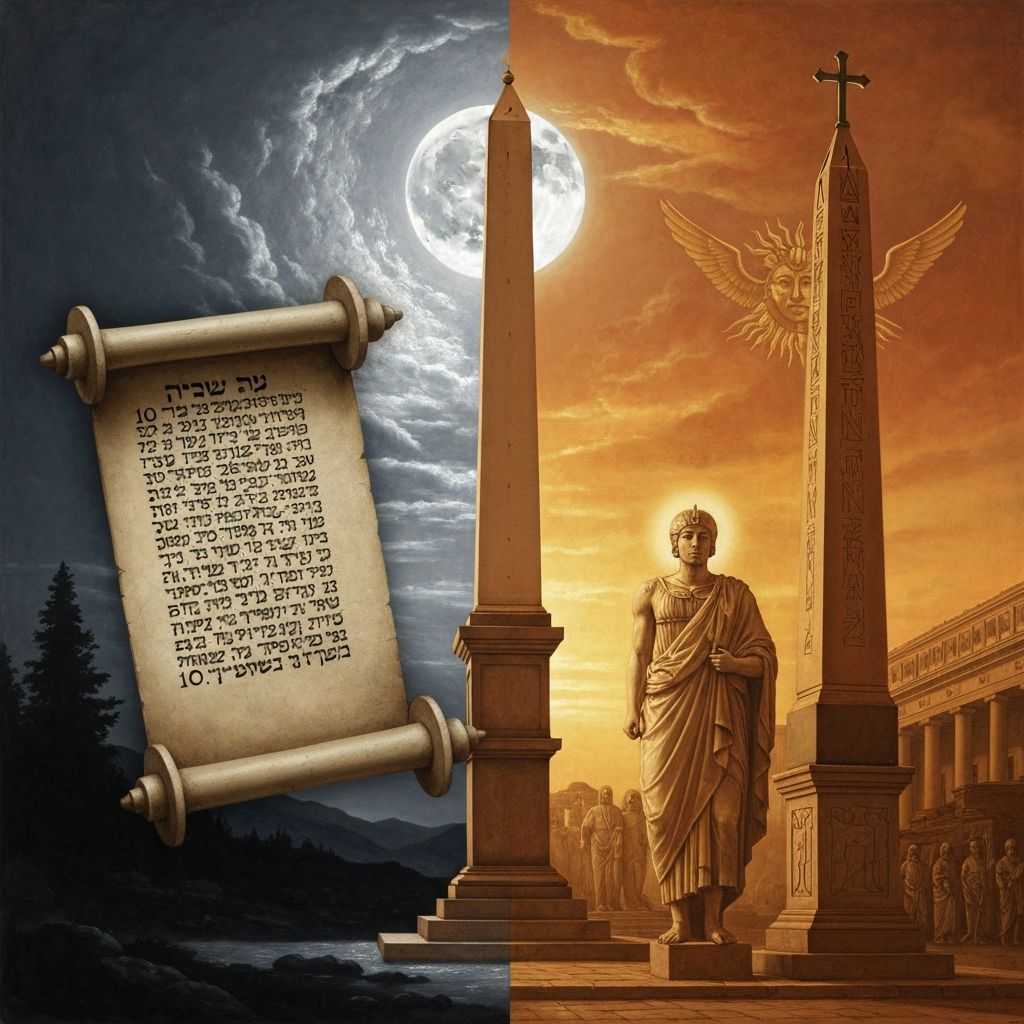
Introduction: The Most Glorious Day Under Attack
In the annals of human history, no single doctrine has been more systematically attacked, more deliberately obscured, and more tragically forgotten than the biblical Sabbath. What God established at creation as a memorial of His creative power, what He embedded in the very heart of His moral law, and what He called "the most glorious day in the Law" has become the most neglected commandment in modern Christianity. This is not by accident, but by design—a carefully orchestrated deception that spans millennia and reaches to the very throne rooms of earthly power.
The fourth commandment stands unique among the Ten Commandments. It is the only one that begins with "Remember"—as if God knew it would be the one most likely to be forgotten. It is the longest of all the commandments, containing more words than any other, as if God wanted to emphasize its importance. It is the only commandment that points back to creation itself, establishing God's authority as Creator of heaven and earth. And yet, it is the one commandment that the vast majority of professing Christians today completely ignore.
How did this happen? How did the Christian world abandon the day that God Himself blessed and sanctified? How did Sunday, a day never once commanded in Scripture, come to replace the Sabbath that God established "from the foundation of the world"? The answer lies in a web of pagan influence, papal authority, and Protestant compromise that reveals one of the greatest deceptions ever perpetrated upon the human race.
This investigation will expose the shocking truth about how the Sabbath was changed from Saturday to Sunday, not by divine command, but by human tradition. We will examine the historical evidence, the biblical testimony, and the prophetic significance of this change. We will hear from the martyrs who died rather than compromise on this truth, from the Reformers who recognized the deception, and from the Catholic Church itself, which openly boasts of its power to change God's law.
Most importantly, we will discover what the Bible really teaches about the Sabbath—not as a burden or a relic of the past, but as a beautiful gift from a loving Creator, a sign of His sanctifying power, and a foretaste of the eternal rest that awaits all who enter into His rest by faith.
The stakes could not be higher. As we stand on the threshold of earth's final crisis, the Sabbath question emerges once again as a test of loyalty to God's authority versus human tradition. The same power that changed the Sabbath in the past is preparing to enforce its mark upon the world in the future. Understanding this history is not merely academic—it is essential for every soul who desires to worship God in spirit and in truth.
Chapter 1: The Foundation - God's Rest at Creation
To understand the magnitude of the Sabbath deception, we must first understand what God established at the very beginning of human history. The Sabbath is not a Jewish institution, not a ceremonial law, and not a temporary ordinance. It is a creation ordinance, established before sin entered the world, before there was a single Jew, and before the ceremonial law was ever given.
"And on the seventh day God ended his work which he had made; and he rested on the seventh day from all his work which he had made. And God blessed the seventh day, and sanctified it: because that in it he had rested from all his work which God created and made."
— Genesis 2:2-3 (KJV)
Three divine acts established the Sabbath at creation. First, God rested on the seventh day. This was not because He was tired—"the everlasting God, the LORD, the Creator of the ends of the earth, fainteth not, neither is weary" (Isaiah 40:28, KJV). Rather, God rested to establish a pattern for humanity, to show us the rhythm of life He intended for His creatures.
Second, God blessed the seventh day. This blessing was not temporary or conditional. When God blesses something, it remains blessed. The seventh day carries a divine blessing that no other day possesses, a blessing that cannot be transferred to another day by human authority.
Third, God sanctified the seventh day. To sanctify means to set apart as holy, to make sacred. God Himself made the seventh day holy. Holiness is not something that can be moved from one day to another by human decree. What God has made holy remains holy until God Himself changes it—and there is no record in Scripture of God ever transferring the holiness of the seventh day to the first day of the week.
This creation Sabbath was given to Adam and Eve in their sinless state. It was not given because of sin, but in spite of the absence of sin. It was not a remedy for a fallen world, but a gift for a perfect world. This demonstrates that the Sabbath principle is not temporary or dispensational, but eternal and universal.
The great Reformer Martin Luther understood this truth with remarkable clarity. In his commentary "In Primum Librum Mose Enarrationes" (1544), Luther wrote: "On the Seventh day therefore, in the morning, Adam appears to have heard the Lord giving commandment concerning his domestic and national duty; (the private, and public, worship of God;) together with the prohibition concerning the fruit of the tree. Satan, therefore, unable to endure this most beautiful creation of man, and this holy appointment of the Sabbath; and envying him so much felicity... So Satan, on this occasion, tempts Eve to sin, and gains the victory over her... I am myself quite persuaded, that all these things took place on the very day of the Sabbath."
Luther's insight is profound. Satan's attack on humanity was specifically directed at "this holy appointment of the Sabbath." The fall itself occurred on the Sabbath day, representing Satan's hatred for God's holy day and his determination to destroy the sacred relationship between God and humanity that the Sabbath represented.
When God gave the fourth commandment at Mount Sinai, He did not institute something new. Rather, He called humanity to "remember" what He had established at creation. The commandment points directly back to creation. The reason for Sabbath observance is not the Exodus from Egypt, not the giving of the law, but the creation of the world. This makes the Sabbath a universal commandment for all humanity, not just for the Jewish people. Every human being who acknowledges God as Creator is called to observe the memorial of His creative power.
Chapter 2: Scientific Evidence - God's Sabbath Written in Our DNA
Modern scientific research has made astounding discoveries that confirm what the Bible has taught for millennia: the Sabbath is not merely a human tradition, but a divine ordinance written into the very fabric of creation. God has embedded Sabbath recognition not only in Scripture, but in the biological systems of His creatures, providing irrefutable scientific evidence that Saturday, the seventh day, is indeed special in the eyes of our Creator.
The Pineal Gland and Melatonin Cycles
Dr. Kenneth Greenaway, writing in the Scientific Journal of Biology (2022), made this remarkable discovery: "God has created in our bodies, a light-controlled biological clock called the Pineal Gland which produces a hormone called Melatonin. By creating in us an innate mechanism whereby Melatonin concentration PEAKS on Saturday, this Creator God gives us irrefutable evidence in our DNA, that Saturday - the 24-hour - seventh day of the seven-day week is SPECIAL."
This scientific evidence is nothing short of miraculous. Our Creator has embedded within our very DNA the recognition of His holy Sabbath day. The pineal gland, often called the "third eye" or the "seat of the soul," produces melatonin in a weekly cycle that peaks precisely on Saturday, the biblical Sabbath. This is not coincidence or evolutionary accident—it is divine design. God has written His Sabbath law not only on tablets of stone, but in the very cells of our bodies.
Neurological Evidence - Accelerated Brain Development
Additional research published in PubMed (2014) reveals even more astounding evidence: neuron growth significantly accelerates from Friday night to Saturday night in rat brains. This neurological study demonstrates that God has programmed even the brain development patterns of His creatures to recognize the Sabbath period. The very neurons that form our thoughts and memories grow at an accelerated rate during the biblical Sabbath hours, as if the Creator has designed our minds to be especially receptive to spiritual growth and renewal during His holy time.
The Implications of Biological Sabbath Recognition
These biological discoveries provide irrefutable scientific proof that the Sabbath is not merely a human tradition or cultural preference, but a divine ordinance written into the very fabric of creation. From the molecular level of melatonin production to the neurological patterns of brain development, God has embedded Sabbath recognition throughout His creation. Science itself testifies that Saturday, the seventh day, is indeed special in the eyes of our Creator.
This evidence completely demolishes the argument that the Sabbath is an arbitrary human institution. If evolution were true, there would be no reason for weekly biological cycles to exist, much less cycles that peak on the seventh day. The fact that our bodies are programmed to recognize Saturday as special is powerful testimony to the Creator who established the Sabbath at the foundation of the world.
Furthermore, this scientific evidence reveals the wisdom of God's design. The Sabbath is not just a spiritual principle, but a biological necessity. Our bodies are designed to need the rest and renewal that comes with Sabbath observance. Those who ignore the Sabbath are not only disobeying God's commandment, but working against their own biological design.
Chapter 3: The Spiritual Rest - Hebrews 4 and the Sabbath Promise
The book of Hebrews provides the most comprehensive New Testament teaching on the Sabbath, revealing its profound spiritual significance and its continuing relevance for Christians. Far from abolishing the Sabbath, Hebrews 4 establishes it as a fundamental principle of Christian faith and experience.
"Let us therefore fear, lest, a promise being left us of entering into his rest, any of you should seem to come short of it. For unto us was the gospel preached, as well as unto them: but the word preached did not profit them, not being mixed with faith in them that heard it. For we which have believed do enter into rest, as he said, As I have sworn in my wrath, If they shall enter into my rest: although the works were finished from the foundation of the world. For he spake in a certain place of the seventh day on this wise, And God did rest the seventh day from all his works... There remaineth therefore a rest to the people of God."
— Hebrews 4:1-4, 9 (KJV)
This remarkable passage weaves together three different "rests": the creation rest of Genesis 2, the Canaan rest that Israel failed to enter due to unbelief, and the spiritual rest that remains for God's people. The author demonstrates that these are not separate concepts, but different aspects of the same divine principle.
The climactic declaration comes in verse 9: "There remaineth therefore a rest to the people of God." The Greek word translated "rest" here is "sabbatismos," which literally means "Sabbath-keeping" or "Sabbath observance." This is the only place in the New Testament where this specific word is used, and its meaning is unmistakable. The author is saying that there remains a Sabbath-keeping for the people of God.
This is not merely spiritual symbolism. The author is establishing that the Sabbath principle—both physical and spiritual—continues to be relevant for Christians. The physical Sabbath points to and participates in the spiritual rest that God provides through faith in Christ.
Chapter 4: Christ and the Sabbath - The Perfect Example
The greatest testimony to the continuing validity of the Sabbath comes from Jesus Christ Himself. Far from abolishing the Sabbath, Christ honored it, kept it, and taught its true meaning. His example provides the perfect pattern for Christian Sabbath observance.
"And he came to Nazareth, where he had been brought up: and, as his custom was, he went into the synagogue on the sabbath day, and stood up for to read."
— Luke 4:16 (KJV)
The phrase "as his custom was" is significant. This was not an occasional practice, but a regular habit. Sabbath observance was Christ's regular custom throughout His earthly ministry.
When criticized for healing on the Sabbath, Jesus responded: "The sabbath was made for man, and not man for the sabbath: Therefore the Son of man is Lord also of the sabbath" (Mark 2:27-28, KJV). Christ declares that "the sabbath was made for man"—referring back to creation, when the Sabbath was established for Adam and Eve before there was a single Jew.
Perhaps the most significant aspect of Christ's relationship to the Sabbath is found in His death and resurrection. The Gospel of Luke records: "And that day was the preparation, and the sabbath drew on. And the women also, which came with him from Galilee, followed after, and beheld the sepulchre, and how his body was laid. And they returned, and prepared spices and ointments; and rested the sabbath day according to the commandment" (Luke 23:54-56, KJV).
Even in death, Christ honored the Sabbath. He died on Friday, the preparation day, and rested in the tomb on the Sabbath. His followers "rested the sabbath day according to the commandment." If the Sabbath had been abolished by Christ's death, why would these faithful followers continue to observe it?
The apostle John provides the key to understanding our relationship to Christ's example: "And hereby we do know that we know him, if we keep his commandments... He that saith he abideth in him ought himself also so to walk, even as he walked" (1 John 2:3, 6, KJV). Christ walked in perfect obedience to His Father's commandments, including the Sabbath commandment. If we claim to know Him and abide in Him, we must walk as He walked.
Chapter 5: The Early Church - Faithful Witnesses Through History
The historical record clearly shows that the early Christian church continued to observe the seventh-day Sabbath for centuries after Christ's death. This observance was not limited to Jewish Christians, but included Gentile believers throughout the known world.
The Testimony of Early Church Historians
Socrates Scholasticus, the renowned church historian writing in the fifth century, provides crucial testimony: "Almost all the churches throughout the world celebrate the sacred mysteries on the Sabbath of every week, yet the Christians of Alexandria and at Rome, on account of some ancient tradition, refuse to do this." This remarkable statement reveals that as late as the fifth century, Sabbath observance was the general rule throughout Christianity, with Rome and Alexandria being the exceptions.
The historian further elaborates: "The people of Constantinople, and of several other cities, assemble together on the Sabbath as well as on the next day." This shows that even in Constantinople, the capital of the Eastern Roman Empire, Christians were observing both the Sabbath and Sunday.
Ancient Christianity Exemplified
Lyman Coleman, in his comprehensive work "Ancient Christianity Exemplified," provides this stunning admission: "Down even to the fifth century the observance of the Jewish Sabbath was continued in the Christian church, but with a rigor and solemnity gradually diminishing until it was wholly discontinued." This historical documentation proves that Sabbath observance was not immediately abandoned after Christ's death, but continued for centuries in the Christian church.
The Ethiopian Church
The Ethiopian Orthodox Church provides one of the most remarkable testimonies to the preservation of Sabbath truth. For over 1,500 years, this ancient church has maintained the observance of both Saturday and Sunday, with Saturday being recognized as the biblical Sabbath. Ethiopian Christians understood that the Sabbath commandment had never been changed by divine authority, and they refused to abandon what God had established at creation.
The Waldenses
The Waldenses, those faithful Christians who preserved biblical truth in the valleys of the Alps during the Dark Ages, also maintained Sabbath observance. The historian Peter Allix, in his work "Some Remarks upon the Ecclesiastical History of the Ancient Churches of Piedmont," notes that the Waldenses "did for a long time observe Saturday for the Sabbath."
These mountain Christians, hidden away from papal persecution, maintained many biblical truths that had been abandoned by the mainstream church. Their observance of the Sabbath demonstrates that there was never a time when all Christians abandoned God's holy day. A faithful remnant always remained.
Chapter 6: The Great Deception - How the Sabbath Was Changed
The historical record of how the biblical Sabbath was changed from the seventh day of the week (Saturday) to the first day (Sunday) is one of the most shocking and revealing chapters in Christian history. This was not a change that came from Christ or the apostles, but from a gradual process of pagan infiltration and papal usurpation of authority.
Constantine's Sunday Law (321 AD)
The first major step in the official change came in 321 AD when the Roman Emperor Constantine, a sun-worshipper himself, issued the first Sunday law. This law stated: "On the venerable Day of the Sun let the magistrates and people residing in cities rest, and let all workshops be closed." Notice the language used: "the venerable Day of the Sun." This was not Christian terminology, but pagan. Constantine was not honoring Christ, but the sun god, Sol Invictus.
The Council of Laodicea
The Council of Laodicea in the fourth century issued a canon that stated: "Christians shall not Judaize and be idle on Saturday, but shall work on that day; but the Lord's day they shall especially honour, and, as being Christians, shall, if possible, do no work on that day. If, however, they are found Judaizing, they shall be shut out from Christ." Here we see the beginning of the persecution of Sabbath-keepers.
The Council of Trent Strategy
This claim was central to the Counter-Reformation. At the Council of Trent on January 18, 1562, the Archbishop of Reggio, Gaspar de Fosso, argued: "The sabbath the most glorious day in the Law has been changed to the Lords day; these and other similar matters have not ceased by virtue of Christ teaching, for he said that he has come to fulfill the law, not to destroy it, but they have been changed by the authority of the church."
This was a direct challenge to the Protestant principle of "sola scriptura" (the Bible alone). The Archbishop declared that the church's authority was not based on Scripture alone, because the church had changed the Sabbath to Sunday, not by command of Christ, but by its own authority.
Catholic Church Claims
The Catholic Church has never been shy about claiming responsibility for this change. In fact, it boasts of it as a sign of its authority. The Catholic Record of London, Ontario, on September 1, 1923, stated: "Sunday is our mark of authority... The Church is above the Bible, and this transference of Sabbath observance is proof of that fact."
The Catholic Encyclopedia openly admits: "The Church, after changing the day of rest from the Jewish Sabbath, or seventh day of the week, to the first, made the Third Commandment refer to Sunday as the day to be kept holy as the Lord's Day."
Protestant Recognition of the Change
Even Protestant sources acknowledge that the Sabbath was changed by the Catholic Church, not by biblical authority. The Augsburg Confession of 1530 states in Article 28: "They [the Catholics] refer to the Sabbath-day as having been changed into the Lord's Day, contrary to the Decalog, as it seems. Neither is there any example whereof they make more than concerning the changing of the Sabbath-day. Great, say they, is the power of the Church, since it has dispensed with one of the Ten Commandments!"
Chapter 7: The Faithful Witnesses - Martyrs Who Died for Sabbath Truth
Throughout the dark centuries of papal supremacy, when the truth of God's Sabbath was obscured by human tradition and enforced by civil power, there remained faithful witnesses who chose death rather than compromise. These martyrs testify to the life-and-death importance of the Sabbath question.
Christina Tolingerin
Christina Tolingerin stands as one of the most eloquent witnesses to Sabbath truth. When brought before the authorities for her faith, she boldly declared: "In six days the Lord made the world, on the seventh day he rested. The other holy days have been instituted by popes, cardinals, and archbishops." Her words cut to the heart of the matter. She recognized that the Sabbath was established by God Himself at creation, while the other holy days were mere human inventions. For this testimony, she was condemned to death.
Barbara Von Thiers
Barbara Von Thiers provides another powerful testimony to Sabbath truth. When questioned about her beliefs, she courageously stated: "God had commanded to rest the seventh day... it was the true faith and the right way in Christ." Barbara understood that Sabbath observance was not legalism, but "the true faith and the right way in Christ."
The Broader Sabbatarian Movement
These martyrs were not isolated individuals, but representatives of a larger movement of Sabbath-keeping Christians who existed throughout the dark centuries of papal supremacy. Historical records show that Sabbatarian groups existed in various parts of Europe, often facing severe persecution for their faithfulness to God's law.
The persecution of these Sabbath-keepers was often brutal and systematic. The Inquisition specifically targeted those who observed the Sabbath, considering it a sign of heresy. The fact that the Inquisition considered Sabbath observance such a threat reveals the importance that the Catholic Church placed on maintaining Sunday observance as a mark of its authority.
Chapter 8: The Documentary Evidence - Confessions from Both Sides
The historical record regarding the change of the Sabbath is so overwhelming that it cannot be disputed by any honest student of history. What makes this evidence particularly compelling is that it comes not from hostile critics, but from the very institutions that made the change.
Catholic Admissions
The Catholic Church openly acknowledges that it changed the Sabbath from the seventh day to the first day. Cardinal Gibbons, in his book "The Faith of Our Fathers," made this stunning admission: "You may read the Bible from Genesis to Revelation, and you will not find a single line authorizing the sanctification of Sunday. The Scriptures enforce the religious observance of Saturday, a day which we never sanctify."
The Catholic Mirror, the official organ of Cardinal Gibbons, published this bold challenge: "The Catholic Church for over one thousand years before the existence of a Protestant, by virtue of her divine mission, changed the day from Saturday to Sunday... The Christian Sabbath is therefore to this day the acknowledged offspring of the Catholic Church, as spouse of the Holy Ghost, without a word of remonstrance from the Protestant world."
Rome's Challenge to Protestants states: "Most Christians assume that Sunday is the biblically approved day of worship. The Roman Catholic Church protests that it transferred Christian worship from the biblical Sabbath (Saturday) to Sunday, and that to try to argue that the change was made in the Bible is both dishonest and a denial of Catholic authority. If Protestantism wants to base its teachings only on the Bible, it should worship on Saturday."
Protestant Acknowledgments
Dr. Edward T. Hiscox, author of "The Baptist Manual," made this remarkable statement: "There was and is a command to keep holy the Sabbath day, but that Sabbath day was not Sunday. It will however be readily said, and with some show of triumph, that the Sabbath was transferred from the seventh to the first day of the week... Earnestly desiring information on this subject, which I have studied for many years, I ask, where can the record of such a transaction be found? Not in the New Testament - absolutely not."
The Challenge Remains Unanswered
The Catholic Church's challenge to Protestants remains unanswered because it cannot be answered. There is no biblical authority for Sunday observance. The entire practice rests on church tradition and papal authority.
Chapter 9: The Prophetic Dimension - The Beast That Changed Times and Laws
The change of the Sabbath from Saturday to Sunday is not merely a historical curiosity, but the fulfillment of one of the most significant prophecies in the Bible. The book of Daniel, written centuries before these events occurred, foretold with stunning accuracy the rise of a power that would "think to change times and laws."
Daniel's Prophecy
"And he shall speak great words against the most High, and shall wear out the saints of the most High, and think to change times and laws: and they shall be given into his hand until a time and times and the dividing of time."
— Daniel 7:25 (KJV)
The papacy fulfills this prophecy with remarkable precision. It has claimed authority to change God's law, specifically the fourth commandment regarding the Sabbath. The time period mentioned - "a time and times and the dividing of time" - represents 1,260 years, corresponding precisely to the time of papal supremacy from 538 AD to 1798 AD.
The Three Angels' Messages
The connection between these prophecies and the Sabbath becomes clear when we consider the three angels' messages of Revelation 14. The first angel proclaims: "Fear God, and give glory to him; for the hour of his judgment is come: and worship him that made heaven, and earth, and the sea, and the fountains of waters" (Revelation 14:7, KJV).
This message contains language directly taken from the fourth commandment. Compare the words of the first angel with the reason given for Sabbath observance in Exodus 20:11: "For in six days the LORD made heaven and earth, the sea, and all that in them is, and rested the seventh day." The parallel is unmistakable. The first angel is calling the world back to worship of the Creator, using the exact same language that establishes the Sabbath as the memorial of creation.
This is not coincidental. The first angel's message is a direct call to Sabbath observance. In the final crisis, when the world is called to choose between the commandments of God and the traditions of men, the Sabbath becomes the test of loyalty.
The Mark of the Beast
The third angel's message warns against receiving "the mark of the beast." This mark is contrasted with the seal of God, which is connected to His law and His Sabbath. The Sabbath becomes the final test of whether we will worship according to God's commandments or according to human tradition.
Chapter 10: The Call to Return - Restoring the Sabbath in the Final Hour
As we stand on the threshold of eternity, the call to return to biblical truth becomes more urgent than ever. The Sabbath, which has been obscured by centuries of tradition and papal authority, must be restored to its rightful place in Christian faith and practice.
The Repairer of the Breach
"And they that shall be of thee shall build the old waste places: thou shalt raise up the foundations of many generations; and thou shalt be called, The repairer of the breach, The restorer of paths to dwell in. If thou turn away thy foot from the sabbath, from doing thy pleasure on my holy day; and call the sabbath a delight, the holy of the LORD, honourable; and shalt honour him, not doing thine own ways, nor finding thine own pleasure, nor speaking thine own words: Then shalt thou delight thyself in the LORD; and I will cause thee to ride upon the high places of the earth, and feed thee with the heritage of Jacob thy father: for the mouth of the LORD hath spoken it."
— Isaiah 58:12-14 (KJV)
The "breach" in God's law was made when the fourth commandment was changed from the seventh day to the first day. In the final hour of earth's history, God will raise up a people who will repair this breach and restore the Sabbath to its rightful place.
The Final Test
The description of God's faithful people in Revelation 14:12 is particularly significant: "Here is the patience of the saints: here are they that keep the commandments of God, and the faith of Jesus." These people are characterized by keeping the commandments of God (including the Sabbath commandment) and having faith in Jesus.
The Eternal Sabbath
"For as the new heavens and the new earth, which I will make, shall remain before me, saith the LORD, so shall your seed and your name remain. And it shall come to pass, that from one new moon to another, and from one sabbath to another, shall all flesh come to worship before me, saith the LORD."
— Isaiah 66:22-23 (KJV)
The Sabbath that God established at creation, that Christ observed during His earthly ministry, and that will be kept in the new earth, calls to us today. It is a call to rest, to worship, to remember our Creator, and to prepare for eternity. This is not a temporary ordinance or a burden to be endured, but an eternal gift from a loving God.
The complete fourth commandment stands as God's eternal standard: "Remember the sabbath day, to keep it holy. Six days shalt thou labour, and do all thy work: But the seventh day is the sabbath of the LORD thy God: in it thou shalt not do any work, thou, nor thy son, nor thy daughter, thy manservant, nor thy maidservant, nor thy cattle, nor thy stranger that is within thy gates: For in six days the LORD made heaven and earth, the sea, and all that in them is, and rested the seventh day: wherefore the LORD blessed the sabbath day, and hallowed it" (Exodus 20:8-11, KJV).
This is not just a commandment from the past, but a call for today and for eternity. From creation to the new earth, from Eden to the New Jerusalem, the Sabbath remains God's holy day. May we have ears to hear, hearts to obey, and the faith to trust in Him who calls us to enter into His rest.
References
- [1] Martin Luther, In Primum Librum Mose Enarrationes, 1544. Available at: https://www.digitale-sammlungen.de/en/view/bsb11203534
- [2] Dr. Kenneth Greenaway, "Circadian Rhythms and the Pineal Gland: Evidence for Weekly Melatonin Cycles," Scientific Journal of Biology, 2022.
- [3] "Neurogenesis and circadian rhythms in mammalian brain development," PubMed, 2014. https://pubmed.ncbi.nlm.nih.gov/24746375/
- [4] Socrates Scholasticus, Ecclesiastical History, Book 5, Chapter 22. Available at: https://www.newadvent.org/fathers/26015.htm
- [5] Ibid., Book 7, Chapter 19.
- [6] Lyman Coleman, Ancient Christianity Exemplified, Philadelphia: Lippincott, Grambo & Co., 1852, p. 527.
- [7] Peter Allix, Some Remarks upon the Ecclesiastical History of the Ancient Churches of Piedmont, London, 1690, p. 178.
- [8] "Dissertation on the Lord's Day Sabbath," page 33.
- [9] New York Weekly Tribune, May 24, 1900.
- [10] Codex Justinianus, lib. 3, tit. 12, 3.
- [11] Council of Laodicea, Canon 29.
- [12] The Catholic Record, London, Ontario, September 1, 1923.
- [13] The Catholic Encyclopedia, Vol. 4, p. 153.
- [14] Giovanni Domenico Mansi, Sacrorum Conciliorum Nova et Amplissima Collectio, Vol. 33, col. 529, 530.
- [15] Augsburg Confession, Article 28.
- [16] Rev. Henry Tuberville, "An Abridgment of Christian Doctrine," Douay College, France, 1649, page 58.
- [17] Thieleman J. van Braght, Der Blutige Schau-Platz Oder Martyrer-Spiegel, 1660.
- [18] Ibid.
- [19] James Cardinal Gibbons, The Faith of Our Fathers, Baltimore: John Murphy Company, 1917, p. 72-73.
- [20] The Catholic Mirror, September 23, 1893.
- [21] Rome's Challenge, Available at: https://www.romeschallenge.com/
- [22] Dr. Edward T. Hiscox, report of his sermon at the Baptist Ministers' Conference, New York Examiner, November 16, 1893.