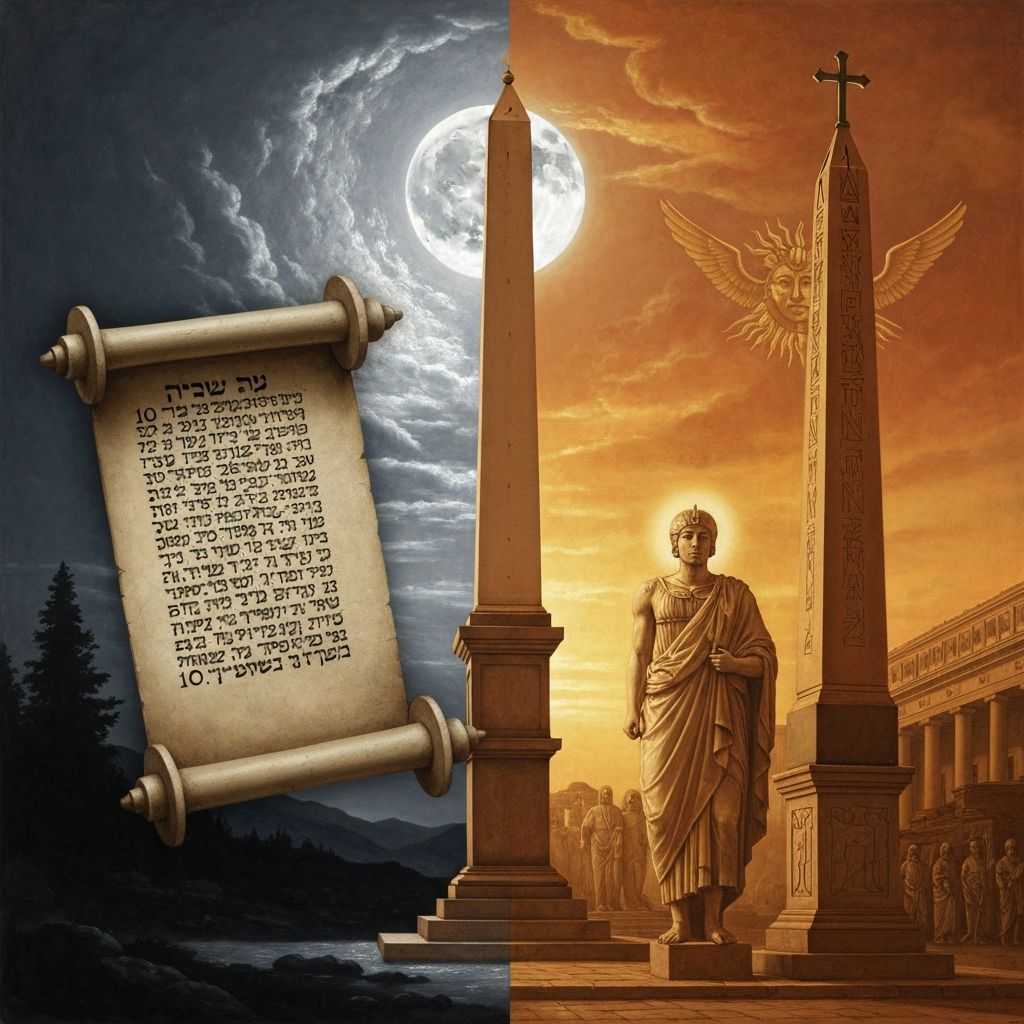
EXPLOSIVE BIBLICAL TRUTH: The Hell Doctrine EXPOSED 🔥
"What if everything you've been taught about hell is a LIE rooted in ancient pagan mythology? This comprehensive biblical investigation will SHOCK you with irrefutable evidence from the original Hebrew and Greek texts."
Table of Contents
Introduction: Unmasking One of Christianity's Greatest Deceptions
For centuries, the doctrine of eternal hellfire has terrorized countless souls and distorted the character of the Almighty. Pulpits across the world echo with dramatic portrayals of sinners burning forever in conscious torment, while well-meaning believers accept this teaching without question. Yet when we examine the original Hebrew and Greek manuscripts of Scripture with the careful precision they deserve, a startling truth emerges: the concept of eternal burning hell is not found anywhere in the inspired Word of the Most High.
This investigation will demonstrate through rigorous biblical scholarship that the doctrine of eternal hellfire is, in fact, a pagan heresy that infiltrated Christianity through mistranslation and the influence of ancient mythology. We shall examine the original language texts, expose the translation errors that have perpetuated this deception, and trace the historical path by which this false teaching entered the church.
The implications of this study are profound. If the traditional doctrine of hell is indeed a fabrication, then we must ask ourselves: What does this reveal about the true character of our Creator? How has this false teaching affected our understanding of divine justice and mercy? And most importantly, what does Scripture actually teach about the fate of the wicked?
As we embark on this scholarly journey, we must approach the text with the reverence it deserves, allowing Scripture to interpret Scripture, and permitting the original languages to speak for themselves. The truth we uncover may challenge long-held beliefs, but it will ultimately reveal a God whose justice is perfect and whose love extends far beyond human comprehension.
Chapter 1: The Original Language Deception - Four Words Mistranslated as "Hell"
The Foundation of Deception
The entire edifice of eternal hellfire doctrine rests upon the mistranslation of four specific words from the original Hebrew and Greek manuscripts. These words—one Hebrew term (שְׁאוֹל sheol) and three Greek terms (ᾅδης hades, τάρταρος tartarus, and γέεννα gehenna)—have been systematically mistranslated to support a doctrine that finds no basis in the inspired text.
When we examine how these words appear in various Bible translations, a shocking pattern emerges. The Latin Vulgate, translated around 400 AD, contains the word "hell" 110 times. The King James Version of 1611 includes it 54 times. Yet remarkably, many modern translations have dramatically reduced or completely eliminated references to "hell" in the Old Testament, with some versions containing zero occurrences of the word.
This dramatic variation in translation reveals a troubling truth: if these words truly meant "hell" in the sense of eternal torment, we would expect consistency across translations. Instead, we find that scholarly examination of the original languages has led many translators to abandon the traditional rendering altogether.
Sheol (שְׁאוֹל): The Hebrew "Grave"
The Hebrew word sheol appears 65 times in the Old Testament manuscripts. Far from describing a place of eternal torment, sheol simply means "the grave" or "the pit"—the place where all the dead go, both righteous and wicked alike.
Consider the testimony of Scripture itself. The patriarch Jacob, certainly a man of faith, expected to go to sheol when he mourned for his son Joseph: "For I will go down into the grave [sheol] unto my son mourning" (Genesis 37:35). Would we dare suggest that this righteous man expected to descend into eternal hellfire?
King David, described as a man after God's own heart, also spoke of going to sheol: "The sorrows of hell [sheol] compassed me about" (2 Samuel 22:6). Yet David also declared that the wicked go to the same place: "The wicked shall be turned into hell [sheol]" (Psalm 9:17). This demonstrates conclusively that sheol was understood as the common destination of all the dead, not a place of punishment for the wicked alone.
The prophet Samuel, when called up by the witch of Endor, came from sheol (1 Samuel 28:13-15). Are we to believe that this holy prophet was suffering in eternal torment? The very suggestion is blasphemous.
Most tellingly, the Messiah Himself was prophesied to go to sheol: "For thou wilt not leave my soul in hell [sheol]; neither wilt thou suffer thine Holy One to see corruption" (Psalm 16:10). This prophecy, quoted in Acts 2:27, confirms that even the sinless Son of the Most High descended to sheol—the grave—not to a place of torment.
Hades (ᾅδης): The Greek Equivalent
The Greek word hades appears 11 times in the New Testament and serves as the direct equivalent of the Hebrew sheol. Like its Hebrew counterpart, hades simply means "the grave" or "the unseen realm of the dead."
The Messiah Himself used this word when He declared: "And thou, Capernaum, which art exalted unto heaven, shalt be brought down to hell [hades]" (Matthew 11:23). He was not threatening the city with eternal torment, but rather declaring that it would be brought low, brought down to the grave, destroyed.
In the account of the rich man and Lazarus (Luke 16:19-31), both men are described as being in hades—yet Lazarus is "comforted" while the rich man is "tormented." This parable (for it is clearly identified as such by its placement among other parables) illustrates that hades contains different compartments or states, not a uniform place of torment.
Most significantly, hades itself is temporary. Revelation 20:13-14 declares: "And the sea gave up the dead which were in it; and death and hell [hades] delivered up the dead which were in them... And death and hell [hades] were cast into the lake of fire." If hades were eternal hell, how could it be cast into the lake of fire? The text clearly distinguishes between hades (the temporary grave) and the lake of fire (the final judgment).
Tartarus (τάρταρος): The Prison of Fallen Angels
The word tartarus appears only once in the entire New Testament, in 2 Peter 2:4: "For if God spared not the angels that sinned, but cast them down to hell [tartarus], and delivered them into chains of darkness, to be reserved unto judgment."
This passage reveals several crucial facts about tartarus. First, it is specifically designated for fallen angels, not human beings. Second, these angels are "reserved unto judgment"—meaning their final punishment is yet future. Third, they are bound "in chains of darkness," suggesting a state of restraint rather than active torment.
The word tartarus itself comes from Greek mythology, where it described a deep abyss used as a dungeon of torment. However, the biblical usage strips away the mythological elements and presents it simply as a place of confinement for rebellious spiritual beings awaiting their final judgment.
Significantly, this is not described as eternal torment, but as a holding place until the day of judgment. The fallen angels are "reserved"—kept in custody—until their case is decided. This contradicts the notion of immediate, eternal punishment upon death.
Gehenna (γέεννα): The Valley of Hinnom
Perhaps no word has been more misunderstood than gehenna, which appears 12 times in the New Testament. Every single occurrence has been mistranslated as "hell" in versions that support the eternal torment doctrine, yet the word refers to a very real, physical location: the Valley of Hinnom outside Jerusalem.
During the time of the Messiah, this valley served as Jerusalem's garbage dump. A fire was constantly maintained there to burn refuse and consume the city's waste. It was also the place where the bodies of criminals and the poor were disposed of when they could not afford proper burial.
When the Messiah spoke of gehenna, He was using a powerful metaphor that His audience would immediately understand. Consider His words in Matthew 5:29-30: "And if thy right eye offend thee, pluck it out, and cast it from thee: for it is profitable for thee that one of thy members should perish, and not that thy whole body should be cast into hell [gehenna]."
Notice that He speaks of the "whole body" being cast into gehenna—not some disembodied soul. This aligns perfectly with the reality of gehenna as a place where physical bodies were burned and consumed. The Messiah was warning of complete destruction, not eternal conscious torment.
The prophet Jeremiah provides additional insight into this location: "Therefore, behold, the days come, saith the LORD, that it shall no more be called Tophet, nor the valley of the son of Hinnom, but the valley of slaughter: for they shall bury in Tophet, till there be no place" (Jeremiah 7:32). This valley was associated with death and destruction, not eternal suffering.
Most importantly, the fire of gehenna accomplished its purpose—it consumed what was thrown into it. The bodies cast there did not burn forever; they were reduced to ash. This provides the perfect metaphor for the final fate of the wicked: complete destruction, not eternal torment.
Chapter 2: The "Eternal" Deception - Mistranslating Time-Related Words
The Second Pillar of False Doctrine
While the mistranslation of sheol, hades, tartarus, and gehenna provides the foundation for hell doctrine, the second pillar supporting this false teaching involves the systematic mistranslation of time-related words. Three specific terms—the Hebrew עוֹלָם (owlam) and the Greek αἰών (aion) and αἰώνιος (aionios)—have been rendered as "eternal," "everlasting," or "forever" when describing divine judgment, despite their actual meanings being far more limited in scope.
Owlam (עוֹלָם): The Hebrew "Age"
The Hebrew word owlam appears throughout the Old Testament and has been consistently mistranslated to support the doctrine of eternal punishment. However, careful examination reveals that owlam simply means "long duration," "antiquity," "futurity," or "until the end of a period of time." The specific duration is determined by the context, not by the word itself.
Consider how owlam is used in contexts where it clearly cannot mean "eternal" in the absolute sense:
The Aaronic priesthood was established "for ever" (owlam) according to Exodus 40:15: "And thou shalt anoint them, as thou didst anoint their father, that they may minister unto me in the priest's office: for their anointing shall surely be an everlasting [owlam] priesthood throughout their generations." Yet we know this priesthood was superseded by the Melchizedek priesthood of the Messiah (Hebrews 7:11-12).
The ceremonial laws were given "for ever" (owlam) in Leviticus 16:34: "And this shall be an everlasting [owlam] statute unto you, to make an atonement for the children of Israel for all their sins once a year." Yet these laws were fulfilled and abolished by the Messiah's sacrifice (Colossians 2:14).
Even slavery was described using owlam in Exodus 21:6: "Then his master shall bring him unto the judges; he shall also bring him to the door, or unto the door post; and his master shall bore his ear through with an aul; and he shall serve him for ever [owlam]." Clearly, this service ended at the slave's death, proving that owlam does not mean absolute eternity.
These examples demonstrate that owlam refers to duration within the context of a particular age or dispensation, not absolute eternity. When applied to divine judgment, it indicates that the punishment will last for the duration of the age in which it occurs, not forever in the absolute sense.
Aion (αἰών): The Greek "Age"
The Greek word aion appears 128 times in the New Testament and, like its Hebrew counterpart, has been systematically mistranslated to support eternal torment doctrine. However, aion fundamentally means "an age"—a period of time with a definite beginning and end.
The Messiah Himself used this word when His disciples asked about "the end of the world [aion]" in Matthew 24:3. They were not asking about the end of the physical planet, but about the end of the age. Similarly, when the Messiah spoke of "the harvest is the end of the world [aion]" in Matthew 13:39, He was referring to the conclusion of a specific time period, not the destruction of the cosmos.
The apostle Paul clearly distinguished between different ages when he wrote of "the wisdom of this world [aion]" (1 Corinthians 1:20) and "the god of this world [aion]" (2 Corinthians 4:4). He also spoke of "the ages [aion] to come" (Ephesians 2:7), demonstrating that there are multiple ages in God's plan.
Most significantly, Paul declared that the Messiah appeared "in the end of the world [aion]" (Hebrews 9:26). If aion meant absolute eternity, this statement would be meaningless. Instead, it indicates that the Messiah appeared at the conclusion of the Old Covenant age.
The expression "for ever and ever" in the King James Version typically translates the Greek phrase "εἰς τοὺς αἰῶνας τῶν αἰώνων" (eis tous aionas ton aionon), literally meaning "unto the ages of the ages." This Hebrew idiom emphasizes the completeness of the time period within its context, not absolute eternity.
Aionios (αἰώνιος): "Age-Lasting," Not "Eternal"
The adjective aionios, derived from aion, appears throughout the New Testament and has been perhaps the most crucial word in establishing the false doctrine of eternal torment. Traditional translations render it as "eternal" or "everlasting," but its true meaning is "age-lasting" or "pertaining to an age."
The critical passage often cited to support eternal torment is Matthew 25:46: "And these shall go away into everlasting [aionios] punishment: but the righteous into life eternal [aionios]." Proponents of eternal hell argue that since the life of the righteous is eternal, the punishment of the wicked must also be eternal.
However, this argument fails on several levels. First, it assumes that aionios means "eternal" in both cases, when the word actually means "age-lasting." Second, it fails to distinguish between the nature of life and the nature of punishment. The righteous receive aionios life—life that belongs to the coming age, which by its very nature is unending. The wicked receive aionios punishment—punishment that belongs to the age of judgment, which accomplishes its purpose and then ends.
Consider how aionios is used in contexts where it clearly cannot mean "eternal":
Romans 16:25 speaks of the mystery "which was kept secret since the world [aionios] began." If aionios means eternal, this passage would suggest that the mystery was kept secret from eternity past, which contradicts the concept of God's eternal plan.
2 Timothy 1:9 mentions grace "given us in Christ Jesus before the world [aionios] began." Again, if aionios means eternal, this creates theological difficulties regarding the nature of God's eternal purposes.
Titus 1:2 refers to eternal life promised "before the world [aionios] began." The same interpretive challenges apply here.
These passages demonstrate that aionios refers to time periods with definite beginnings, not absolute eternity. When applied to punishment, it indicates that the judgment will last for the duration of the age in which it occurs—until its purpose is accomplished.
The Contextual Principle
The fundamental principle for understanding these time-related words is context. When owlam, aion, or aionios describe the attributes of the Almighty—His love, mercy, power, or existence—they appropriately convey the concept of eternity, because the Most High is eternal by nature. However, when these same words describe temporal judgments or punishments, they indicate duration within the context of the age in which they occur.
This principle is consistently applied throughout Scripture. The "everlasting [aionios] gospel" (Revelation 14:6) is eternal because it reveals the eternal character of the Most High. The "everlasting [aionios] covenant" (Hebrews 13:20) is eternal because it is established by the eternal God. But "everlasting [aionios] punishment" is age-lasting because it serves the temporal purpose of correction and restoration within God's plan of the ages.
The Testimony of Bible Versions
The recognition that these words do not inherently mean "eternal" is reflected in the translation choices of various Bible versions. Young's Literal Translation consistently renders aionios as "age-during" rather than "eternal." The Rotherham Emphasized Bible and the Emphatic Diaglott also avoid the traditional "eternal" rendering in many contexts.
Even Strong's Concordance acknowledges that aion can mean "an age" and that aionios can mean "age-long." Thayer's Greek Lexicon similarly recognizes both temporal and eternal meanings for these words, depending on context.
The fact that scholarly translators have moved away from the traditional "eternal" rendering in many passages demonstrates that the linguistic evidence does not support the doctrine of eternal torment. When we allow the original languages to speak for themselves, free from doctrinal bias, the foundation of eternal hell doctrine crumbles.
Chapter 3: The Pagan Invasion - How Ancient Mythology Corrupted Christian Doctrine
The Shocking Historical Truth
The doctrine of eternal hellfire did not originate from the inspired Scriptures. Instead, it represents one of the most successful infiltrations of pagan mythology into Christian theology. When we trace the historical development of this teaching, we discover that it emerged from the same ancient sources that gave us the mythologies of Egypt, Greece, and Rome—sources that the early believers would have recognized as fundamentally opposed to biblical truth.
Ancient Egyptian Origins
The concept of fiery eternal punishment first appears in ancient Egyptian religious texts, particularly in the funerary document known as the Book Ȧm-Ṭuat (Amduat). This text, which historians date to the early periods of Egyptian civilization, describes elaborate underworld torments for those who failed to properly navigate the afterlife journey.
Egyptian mythology depicted the afterlife as a complex realm where the dead faced judgment before Osiris, the god of the underworld. Those found wanting were subjected to various forms of eternal punishment, including burning in lakes of fire. The Egyptian concept included detailed descriptions of demons tormenting the wicked and fires that never consumed their victims—elements that would later appear in Christian descriptions of hell.
These Egyptian beliefs were not isolated religious concepts but formed part of a comprehensive worldview that included multiple gods, magical incantations, and elaborate rituals designed to ensure safe passage through the afterlife. The idea that the Creator of the universe would establish a system of eternal torture was perfectly consistent with the capricious and often cruel nature of the Egyptian pantheon.
Greek Philosophical Development
The Egyptian concepts were refined and philosophically developed by Greek thinkers, most notably Plato (427-347 BC). In his dialogue "Gorgias," Plato presents a detailed description of eternal punishment in the afterlife, complete with judges who determine the fate of souls and various levels of torment based on the severity of earthly crimes.
Plato's "Phaedo" further developed these concepts, describing the soul's journey after death and the eternal consequences of moral choices. These philosophical works provided a sophisticated intellectual framework for the concept of eternal punishment, making it appear reasonable and just to educated minds.
The Greek mythological system, as recorded in Homer's "Odyssey" and other classical works, depicted the underworld as a vast network of regions with different purposes:
- Hades served as the general realm of the dead, ruled by the god of the same name and his queen Persephone. Entry required crossing the River Styx, guarded by Cerberus, the three-headed dog. Once inside, souls faced judgment by three legendary figures: Minos, Rhadamanthys, and Aiakos.
- Elysium was reserved for heroes and the distinguished, a place of eternal bliss and reward.
- Asphodel Meadows housed ordinary souls who lived neither particularly virtuous nor particularly wicked lives.
- Tartarus represented the deepest region of the underworld, far below the earth, where the exceptionally evil endured endless punishment for their crimes. This realm was characterized by eternal torment, with victims suffering punishments specifically designed to match their earthly sins.
The Greek concept of Tartarus bears striking similarities to the later Christian doctrine of hell. Both describe a place of eternal conscious torment, both emphasize the justice of eternal punishment for temporal crimes, and both present the suffering as conscious and unending.
Roman Adaptation and Expansion
The Romans adopted and expanded upon Greek concepts, as evidenced in works like Virgil's "Aeneid." In Book VI, Virgil describes the hero Aeneas's descent into the underworld, where he witnesses the wicked being tormented in various ways. This literary work became highly influential in Roman culture and provided detailed imagery that would later influence Christian descriptions of hell.
Roman religious thought also incorporated concepts from other conquered territories, creating a syncretic system that blended various mythological traditions. The Roman emphasis on law and justice provided additional philosophical justification for the concept of eternal punishment as divine retribution for earthly crimes.
The Hellenization of Jewish Thought
The critical turning point in the infiltration of these pagan concepts into biblical religion occurred during the Hellenistic period, particularly following the conquests of Alexander the Great in the fourth century BC. As Greek culture spread throughout the Mediterranean world, Jewish communities found themselves immersed in Hellenistic thought and culture.
Prior to this period, Jewish understanding of the afterlife was remarkably different from later Christian doctrine. The Hebrew Scriptures consistently taught that all the dead—both righteous and wicked—went to sheol, the grave. This was understood as a place of rest and unconsciousness, not a realm of punishment or reward.
The book of Ecclesiastes clearly expresses this understanding: "For the living know that they shall die: but the dead know not any thing, neither have they any more a reward; for the memory of them is forgotten" (Ecclesiastes 9:5). This passage, along with many others, demonstrates that the original Hebrew understanding of death involved unconsciousness, not conscious existence in another realm.
However, as Jewish communities became increasingly Hellenized, Greek concepts of the afterlife began to influence Jewish thought. Intertestamental literature, such as the books of Enoch and 2 Esdras, shows clear evidence of this Greek influence, introducing concepts of eternal punishment and conscious existence after death that were foreign to the original Hebrew Scriptures.
Early Christian Resistance and Capitulation
The early Christian church initially resisted these pagan influences. Historical evidence reveals that during the first five centuries of Christianity, there were six major theological schools, and their positions on the afterlife were remarkably different from later orthodox doctrine:
- Four schools (Alexandria, Antioch, Caesarea, and Edessa/Nisibis) taught universal reconciliation—the belief that all would ultimately be saved.
- One school (Ephesus) accepted conditional mortality—the belief that the wicked would simply cease to exist.
- Only one school (Carthage/Rome) taught endless punishment of the wicked.
This historical fact is documented in The Schaff-Herzog Encyclopedia of Religious Knowledge and demonstrates that the doctrine of eternal hell was a minority position in early Christianity. The majority of early Christian theologians, including many who were closer to the apostolic period than later church fathers, rejected the concept of eternal torment.
Notable early Christian thinkers who opposed eternal torment included:
Clement of Alexandria (150-215 AD) taught that God's punishments were corrective and restorative, not retributive. He believed that even the worst sinners would eventually be purified and restored to fellowship with the Creator.
Origen (185-254 AD), one of the most influential early theologians, explicitly taught universal reconciliation. He argued that God's love and justice required that all rational beings would ultimately be restored to their original state of perfection.
Gregory of Nyssa (335-395 AD) continued the tradition of universal reconciliation, teaching that God's punishments were medicinal rather than punitive.
The Roman Catholic Transformation
The transformation of Christian doctrine regarding the afterlife occurred primarily through the influence of the Roman Catholic Church, particularly through three key figures:
Tertullian (160-220 AD), a Roman Catholic theologian, was among the first to strongly advocate for eternal torment. His legal background and Roman cultural context influenced his understanding of divine justice as requiring eternal punishment for temporal crimes.
Jerome (347-420 AD) played the most crucial role in establishing eternal hell doctrine through his translation work. Commissioned by Pope Damasus in 382 AD to produce a revised Latin translation of the Bible, Jerome systematically mistranslated key Hebrew and Greek words to support the doctrine of eternal punishment.
Jerome's Latin Vulgate became the official Bible of the Roman Catholic Church and remained the dominant biblical text for over a thousand years. During this period, the mistranslations became so entrenched that they were accepted as authentic biblical teaching.
Augustine (354-430 AD) provided the theological framework that made eternal torment appear doctrinally sound. His development of the doctrine of "eternal conscious torment" gave intellectual respectability to what was essentially a pagan concept dressed in Christian terminology.
Augustine's influence cannot be overstated. His theological system became the foundation for both Roman Catholic and later Protestant doctrine. His acceptance of eternal hell as divine justice provided the theological justification that allowed this pagan concept to become orthodox Christian teaching.
The Dark Ages and Doctrinal Entrenchment
From approximately 590 to 1517 AD, the Roman Catholic Church exercised unprecedented control over Western civilization. During this period, known as the Dark Ages, the church controlled not only religious doctrine but also education, politics, philosophy, and the arts.
The church's strategy for maintaining doctrinal control was simple but effective: restrict access to the Scriptures. Only priests were educated in Latin, and possession of non-Latin Scriptures was punishable by persecution and sometimes death. This enforced ignorance allowed the church to present its doctrines, including eternal hell, as unquestionable biblical truth.
The first English translation of the Bible was produced around 1380 AD by John Wycliffe, who translated from the Latin Vulgate because it was the only source available to him. The church's reaction to Wycliffe's work demonstrates their commitment to maintaining doctrinal control: Pope Martin V was so enraged by Wycliffe's translation that, 44 years after Wycliffe's death, he ordered the translator's bones to be dug up, crushed, and scattered in a river.
The Protestant Reformation's Incomplete Reform
The Protestant Reformation, initiated by Martin Luther in 1517, challenged many Roman Catholic doctrines and practices. Luther's posting of his 95 Theses marked the beginning of a movement that would transform Christianity and Western civilization.
However, the Reformation was incomplete in its rejection of Roman Catholic error. While Luther and other reformers abandoned many unbiblical Catholic teachings, they retained the doctrine of eternal hell. This failure occurred for several reasons:
First, the supremacy of the Latin Vulgate meant that even Protestant translators were influenced by Jerome's mistranslations. The King James Version of 1611, which became the standard Protestant Bible for centuries, copied many of the translation errors found in the Latin Vulgate.
Second, the dominating influence of Augustinian theology meant that Protestant reformers accepted Augustine's theological framework, including his doctrine of eternal conscious torment.
Third, the cultural entrenchment of hell doctrine made it difficult for reformers to recognize it as a pagan infiltration. After more than a thousand years of church teaching, eternal hell had become so associated with Christianity that questioning it seemed tantamount to questioning the faith itself.
Literary and Cultural Reinforcement
The entrenchment of hell doctrine was further reinforced by influential literary works that captured the popular imagination. Dante's "Divine Comedy," particularly the "Inferno" section, provided vivid and detailed descriptions of hell that became more influential than Scripture itself in shaping popular understanding of the afterlife.
Dante's work, heavily influenced by Virgil's "Aeneid," presented a systematic description of hell with nine circles of punishment, each designed for specific categories of sin. While Dante intended his work as allegory, it became so influential that many Christians began to view his descriptions as biblically accurate.
The "Gospel of Nicodemus," another influential work, represented a clear syncretism between Christian and ancient Greek ideas. This text, which describes the Messiah's descent into hell, further reinforced the concept of hell as a place of conscious torment.
These literary works demonstrate how pagan concepts, once introduced into Christian thought, became self-reinforcing through cultural expression and popular imagination.
The Theological Contradiction
The adoption of eternal hell doctrine created a fundamental theological contradiction that has plagued Christianity for centuries. The Scriptures clearly declare that the Most High is love (1 John 4:8), that His mercy endures forever (Psalm 136), and that He desires all to be saved (1 Timothy 2:4). Yet the doctrine of eternal hell presents a God who will torture the majority of His creation forever for finite crimes committed in a brief earthly existence.
This contradiction has forced theologians into increasingly complex explanations to reconcile the character of a loving God with the doctrine of eternal torment. The result has been a distorted understanding of divine justice that emphasizes punishment over restoration and retribution over reconciliation.
The pagan origin of this doctrine explains the contradiction. Ancient pagan gods were indeed capricious and cruel, capable of inflicting eternal punishment for temporal offenses. But the God revealed in Scripture is fundamentally different—a God whose justice is always tempered by mercy and whose punishments are always corrective rather than merely punitive.
Modern Scholarly Recognition
Contemporary biblical scholarship has increasingly recognized the pagan origins of eternal hell doctrine. The discovery and translation of ancient texts have revealed the clear connections between Christian hell doctrine and earlier pagan beliefs. Archaeological evidence has confirmed the antiquity of these concepts in Egyptian, Greek, and Roman sources.
Furthermore, linguistic analysis of the original Hebrew and Greek texts has demonstrated that the words traditionally translated as "hell" and "eternal" do not support the doctrine of eternal torment. This scholarly work has led many modern translations to abandon or significantly modify the traditional renderings.
The recognition of these facts has led to a growing movement within Christianity to reconsider the doctrine of eternal hell. Many theologians, pastors, and biblical scholars now acknowledge that this teaching represents a corruption of biblical truth rather than an authentic expression of divine revelation.
The Path Forward
Understanding the pagan origins of eternal hell doctrine is not merely an academic exercise—it has profound implications for how we understand the character of the Most High and the nature of His plan for creation. When we recognize that this doctrine represents a foreign intrusion into biblical truth, we are freed to rediscover what Scripture actually teaches about divine justice, mercy, and the ultimate fate of humanity.
The evidence is clear: the doctrine of eternal hellfire is not a biblical teaching but a pagan heresy that has masqueraded as Christian truth for far too long. The time has come to expose this deception and return to the pure truth of Scripture, which reveals a God whose love is truly unconditional and whose justice is always redemptive.
Chapter 4: What Scripture Actually Teaches - The Biblical Doctrine of Divine Justice
The True Biblical Pattern
Having exposed the pagan origins and linguistic deceptions that support eternal hell doctrine, we must now examine what the inspired Scriptures actually teach about the fate of the wicked. When we approach the text without the bias of traditional interpretation, allowing Scripture to interpret Scripture, a remarkably different picture emerges—one that reveals the true character of divine justice and mercy.
The Fundamental Principle: Death as Wages of Sin
The apostle Paul establishes the foundational principle in Romans 6:23: "For the wages of sin is death; but the gift of God is eternal life through Jesus Christ our Lord." This verse presents a clear contrast: the consequence of sin is death, while the gift of righteousness is life. There is no mention of eternal torment—only death as the ultimate penalty for sin.
This principle is consistently maintained throughout Scripture. Genesis 2:17 records the original warning: "But of the tree of the knowledge of good and evil, thou shalt not eat of it: for in the day that thou eatest thereof thou shalt surely die." The penalty for disobedience was death, not eternal torture.
Ezekiel 18:4 reaffirms this principle: "Behold, all souls are mine; as the soul of the father, so also the soul of the son is mine: the soul that sinneth, it shall die." Again, the penalty is death, not eternal suffering.
The consistency of this teaching throughout Scripture demonstrates that death—cessation of existence—is the biblical penalty for sin, not eternal conscious torment.
The Nature of Death in Scripture
To understand the biblical teaching about the fate of the wicked, we must first understand what Scripture teaches about the nature of death itself. The biblical view of death stands in stark contrast to the Greek philosophical concept of an immortal soul that continues conscious existence after bodily death.
Ecclesiastes 9:5-6 provides a clear description of death: "For the living know that they shall die: but the dead know not any thing, neither have they any more a reward; for the memory of them is forgotten. Also their love, and their hatred, and their envy, is now perished; neither have they any more a portion for ever in any thing that is done under the sun."
This passage teaches that death involves:
- Complete unconsciousness ("know not any thing")
- Cessation of emotions ("love, hatred, and envy...perished")
- No participation in earthly affairs ("no more a portion...in any thing")
Psalm 146:4 confirms this understanding: "His breath goeth forth, he returneth to his earth; in that very day his thoughts perish." Death involves the cessation of thought and consciousness, not the continuation of existence in another realm.
Job 14:10-12 provides additional insight: "But man dieth, and wasteth away: yea, man giveth up the ghost, and where is he? As the waters fail from the sea, and the flood decayeth and drieth up: So man lieth down, and riseth not: till the heavens be no more, they shall not awake, nor be raised out of their sleep."
This passage compares death to sleep—a state of unconsciousness that continues until the resurrection. The dead do not immediately go to heaven or hell; they remain unconscious in the grave until the day of judgment.
The Resurrection and Judgment
The biblical teaching about the fate of the wicked cannot be understood apart from the doctrine of resurrection. Scripture consistently teaches that judgment occurs after resurrection, not immediately at death.
Daniel 12:2 describes the resurrection: "And many of them that sleep in the dust of the earth shall awake, some to everlasting life, and some to shame and everlasting contempt." Notice that both groups "awake"—they are resurrected from the unconscious state of death.
The Messiah confirmed this teaching in John 5:28-29: "Marvel not at this: for the hour is coming, in the which all that are in the graves shall hear his voice, And shall come forth; they that have done good, unto the resurrection of life; and they that have done evil, unto the resurrection of damnation."
This passage establishes several crucial points:
- All the dead are currently "in the graves," not in heaven or hell
- There will be a future resurrection of both righteous and wicked
- Judgment occurs after resurrection, not before
Revelation 20:11-15 provides the most detailed description of the final judgment: "And I saw a great white throne, and him that sat on it, from whose face the earth and the heaven fled away; and there was found no place for them. And I saw the dead, small and great, stand before God; and the books were opened: and another book was opened, which is the book of life: and the dead were judged out of those things which were written in the books, according to their works. And the sea gave up the dead which were in it; and death and hell delivered up the dead which were in them: and they were judged every man according to their works. And whosoever was not found written in the book of life was cast into the lake of fire. This is the second death. And death and hell were cast into the lake of fire."
This passage reveals that:
- The dead are resurrected for judgment ("the dead...stand before God")
- Death and hades (the grave) give up their dead
- Those not found in the book of life experience "the second death"
- Death and hades themselves are destroyed in the lake of fire
The Lake of Fire: Complete Destruction, Not Eternal Torment
The "lake of fire" mentioned in Revelation has been misunderstood as a place of eternal torment, but careful examination reveals that it represents complete destruction—the "second death."
Revelation 20:14 explicitly identifies the lake of fire: "This is the second death." Death, by definition, is the cessation of life, not the continuation of existence in torment. The "second death" represents final, permanent death—extinction of being.
The symbolism of fire throughout Scripture consistently represents destruction and consumption, not preservation in torment. Consider these examples:
Malachi 4:1-3: "For, behold, the day cometh, that shall burn as an oven; and all the proud, yea, and all that do wickedly, shall be stubble: and the day that cometh shall burn them up, saith the LORD of hosts, that it shall leave them neither root nor branch. But unto you that fear my name shall the Sun of righteousness arise with healing in his wings; and ye shall go forth, and grow up as calves of the stall. And ye shall tread down the wicked; for they shall be ashes under the soles of your feet in the day that I shall do this, saith the LORD of hosts."
This passage teaches that the wicked will be:
- Burned up completely ("leave them neither root nor branch")
- Reduced to ashes ("ashes under the soles of your feet")
- Completely destroyed, not preserved in torment
2 Peter 3:7 describes the same event: "But the heavens and the earth, which are now, by the same word are kept in store, reserved unto fire against the day of judgment and perdition of ungodly men." The word "perdition" (Greek: ἀπώλεια, apoleia) means destruction or ruin, not eternal preservation in torment.
The Testimony of the Messiah
The words of the Messiah Himself provide the clearest teaching about the fate of the wicked. In Matthew 10:28, He declared: "And fear not them which kill the body, but are not able to kill the soul: but rather fear him which is able to destroy both soul and body in hell [gehenna]."
This verse teaches that the Most High is able to "destroy" both soul and body. The Greek word translated "destroy" is ἀπόλλυμι (apollumi), which means to destroy utterly, to put out of existence. This is not preservation in torment but complete annihilation.
John 3:16 presents the fundamental choice: "For God so loved the world, that he gave his only begotten Son, that whosoever believeth in him should not perish, but have everlasting life." The contrast is between perishing and having life, not between eternal torment and eternal bliss.
The Greek word translated "perish" is ἀπόλλυμι (apollumi), the same word used in Matthew 10:28. It means to be destroyed, to cease to exist. The choice is between life and death, existence and non-existence.
The Parable of the Tares
The Messiah's parable of the tares (Matthew 13:24-30, 36-43) provides additional insight into the fate of the wicked. In His explanation of the parable, He states: "As therefore the tares are gathered and burned in the fire; so shall it be in the end of this world [aion]. The Son of man shall send forth his angels, and they shall gather out of his kingdom all things that offend, and them which do iniquity; And shall cast them into a furnace of fire: there shall be weeping and gnashing of teeth."
The key element in this parable is what happens to tares when they are burned: they are consumed and destroyed. Fire does not preserve tares in eternal torment; it reduces them to ash. The "weeping and gnashing of teeth" describes the anguish of those facing destruction, not the experience of eternal torment.
The Destruction of Sodom and Gomorrah as a Type
The destruction of Sodom and Gomorrah provides a biblical type of the final judgment of the wicked. Jude 7 states: "Even as Sodom and Gomorrha, and the cities about them in like manner, giving themselves over to fornication, and going after strange flesh, are set forth for an example, suffering the vengeance of eternal [aionios] fire."
Sodom and Gomorrah suffered "eternal fire," yet these cities are not burning today. The fire was "eternal" in its effects—it completely destroyed the cities and they were never rebuilt. Similarly, the "eternal fire" that destroys the wicked will be eternal in its effects, not in its duration.
2 Peter 2:6 confirms this interpretation: "And turning the cities of Sodom and Gomorrha into ashes condemned them with an overthrow, making them an ensample unto those that after should live ungodly." The cities were reduced to ashes—completely destroyed—providing an example of what will happen to the ungodly.
The Testimony of the Psalms
The Psalms consistently teach that the wicked will be destroyed, not preserved in eternal torment:
- Psalm 37:10: "For yet a little while, and the wicked shall not be: yea, thou shalt diligently consider his place, and it shall not be." The wicked "shall not be"—they will cease to exist.
- Psalm 37:20: "But the wicked shall perish, and the enemies of the LORD shall be as the fat of lambs: they shall consume; into smoke shall they consume away." The wicked will "consume away" like smoke—they will be completely destroyed.
- Psalm 68:2: "As smoke is driven away, so drive them away: as wax melteth before the fire, so let the wicked perish at the presence of God." Again, the wicked "perish"—they are destroyed, not preserved.
- Psalm 104:35: "Let the sinners be consumed out of the earth, and let the wicked be no more." The wicked will be "consumed" and "be no more"—they will cease to exist.
The Problem with Immortal Soul Doctrine
The doctrine of eternal torment depends entirely upon the unbiblical teaching that human beings possess immortal souls that cannot be destroyed. However, Scripture teaches that immortality is a gift of the Most High, not an inherent human characteristic.
1 Timothy 6:15-16 declares that the Most High "only hath immortality." If only the Most High possesses immortality, then human beings are not inherently immortal.
1 Corinthians 15:53-54 teaches that immortality is put on at the resurrection: "For this corruptible must put on incorruption, and this mortal must put on immortality. So when this corruptible shall have put on incorruption, and this mortal shall have put on immortality, then shall be brought to pass the saying that is written, Death is swallowed up in victory."
This passage clearly teaches that immortality is not inherent but is granted to the righteous at the resurrection. The wicked, who are not granted immortality, remain mortal and can therefore be destroyed.
The Justice of Proportional Punishment
The biblical doctrine of destruction rather than eternal torment reveals the true justice of the Most High. Divine justice requires that punishment be proportional to the crime committed. Eternal torment for finite sins committed in a brief earthly existence would be infinitely disproportionate and therefore unjust.
However, the biblical teaching of destruction provides perfect justice. The wicked receive the ultimate penalty—loss of life itself—but this penalty is proportional to their rejection of the gift of life offered through the Messiah.
Luke 12:47-48 teaches the principle of proportional punishment: "And that servant, which knew his lord's will, and prepared not himself, neither did according to his will, shall be beaten with many stripes. But he that knew not, and did commit things worthy of stripes, shall be beaten with few stripes. For unto whomsoever much is given, of him shall be much required: and to whom men have committed much, of him they will ask the more."
This passage teaches that punishment varies according to knowledge and opportunity. Some receive "many stripes," others "few stripes." This principle of proportional punishment is incompatible with the doctrine of equal eternal torment for all the wicked.
The Ultimate Victory of Love
The biblical doctrine of the destruction of the wicked, rather than their eternal torment, reveals the ultimate victory of divine love. When sin and sinners are finally destroyed, the universe will be cleansed of all rebellion and suffering. There will be no corner of creation where conscious beings continue to suffer eternally.
Revelation 21:4 describes this final state: "And God shall wipe away all tears from their eyes; and there shall be no more death, neither sorrow, nor crying, neither shall there be any more pain: for the former things are passed away."
If the wicked were suffering eternally in hell, this promise could not be fulfilled. There would always be death, sorrow, crying, and pain in the universe. But when the wicked are destroyed—when they experience the second death—then truly "there shall be no more pain."
1 Corinthians 15:26 declares: "The last enemy that shall be destroyed is death." When death itself is destroyed, there will be no more dying, no more suffering, no more separation from the Most High. The universe will be restored to its original perfection, with love reigning supreme throughout all creation.
This is the true biblical teaching about the fate of the wicked: not eternal preservation in torment, but complete destruction, allowing love and life to triumph eternally throughout the universe. This doctrine reveals a God whose justice is perfect, whose mercy is infinite, and whose love will ultimately prevail over all evil.