The Question Before Us
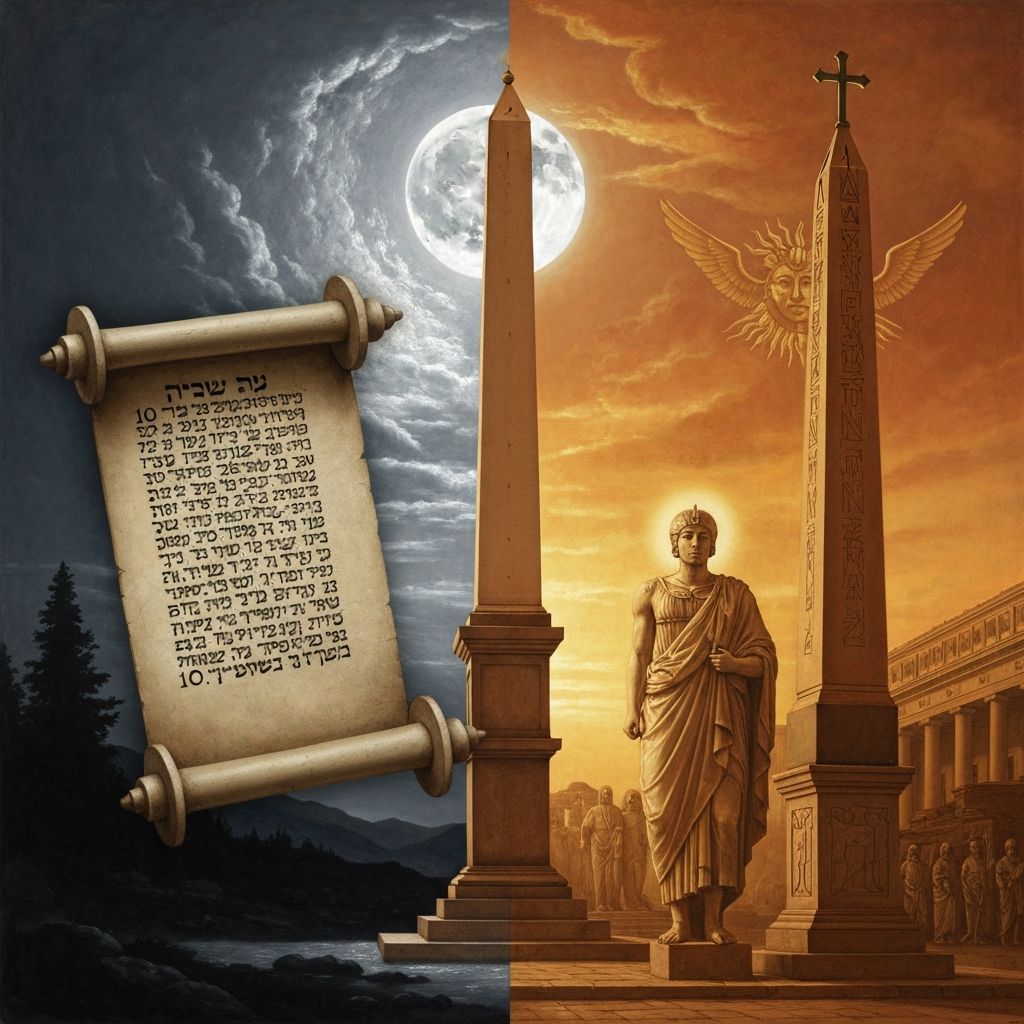
Ladies and gentlemen, there is a question that is rising in our nation, and it is not a political question. It is a prophetic one. Many sincere Christians today look at the moral decline around them, and they say, "We must get back to our roots. We must make this a Christian nation again." And the sentiment is understandable. But I want to ask a simple question, and I want you to think it through carefully:
Which roots? Do we want to get back to the freedom roots of our nation—or to its persecution roots?
Because America has both. Before there was a First Amendment, there were colonies with established churches, compulsory church taxes, laws against "heresy," whipping posts for Baptists, banishment for dissenters, and gallows for Quakers. The people who wielded that power were not atheists. They were Christians—devout, Bible-quoting, Sabbath-keeping (as they understood it) Christians—who were convinced that the state had a duty to enforce true religion.
And the people who suffered under that power were also Christians. They were the ones who read their Bibles and concluded that Christ never gave the sword to the church. It is their blood, their prison writings, and their arguments that became the First Amendment. So when someone tells you that the separation of church and state is an invention of secularists to drive God out of public life, you need to know the history. It was the persecuted believers who built that wall—and they built it to protect the garden of the church.
And there is a reason this matters so urgently: the Bible predicts that the very nation which rose on the principle of liberty would one day speak with another voice.
Part 1: The Beast With Lamb-Like Horns
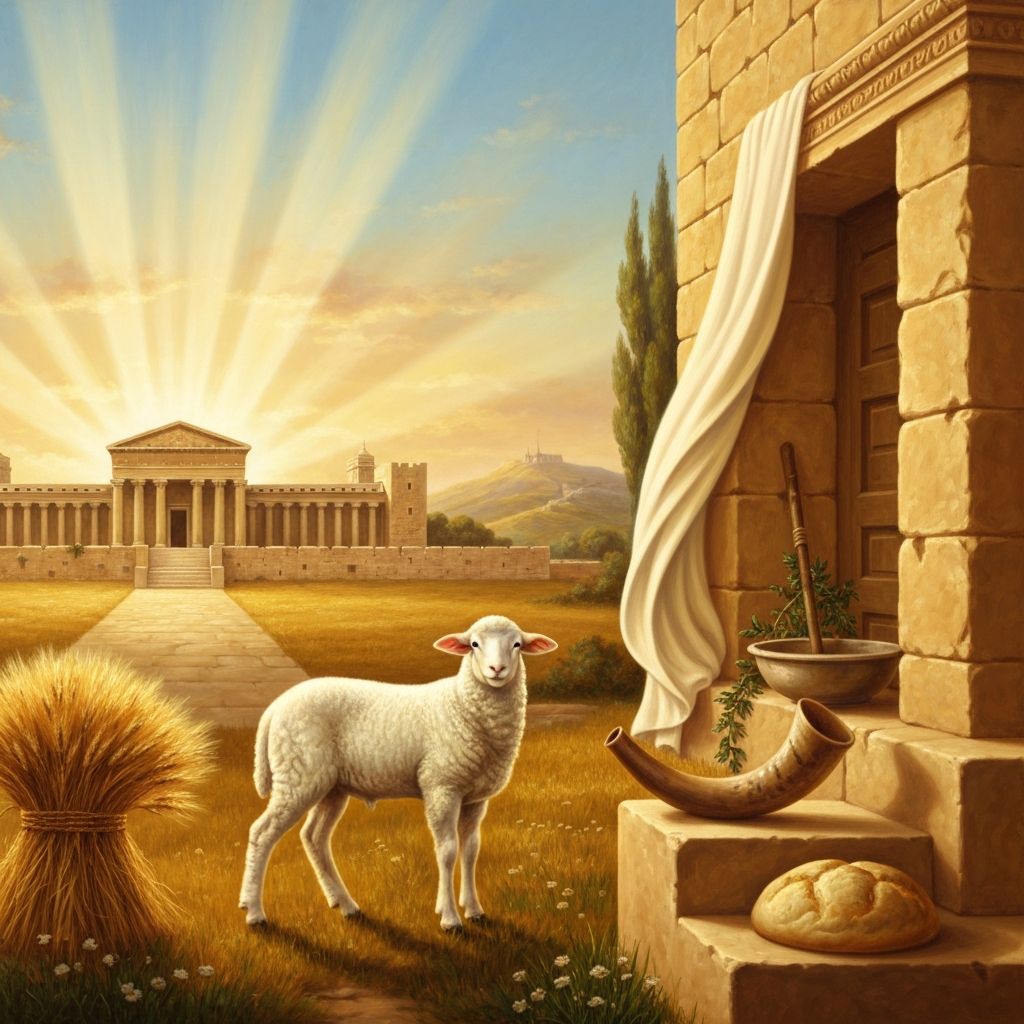
"And I beheld another beast coming up out of the earth; and he had two horns like a lamb, and he spake as a dragon."
— Revelation 13:11 (KJV)
Now notice the details, because in prophecy every detail counts. The first beast of Revelation 13 rises out of the sea—and the sea, the Bible tells us, represents "peoples, and multitudes, and nations, and tongues" (Revelation 17:15). That first beast arose in the crowded, war-torn heart of the Old World. It received its seat and great authority from the dragon (Revelation 13:2), it ruled for 42 prophetic months (1260 years), and it received a deadly wound.
But this second beast comes up out of the earth—a sparsely populated region, a new land, rising not by conquest over other nations but growing up quietly, like a plant from the soil. It appears on the stage of history precisely around the time the first beast receives its wound at the end of the 18th century. And unlike the ten-horned beasts of Daniel and Revelation, this one has no crowns on its horns. No kings.
Two Horns Like a Lamb
A lamb is the symbol of Christ Himself—"the Lamb of God, which taketh away the sin of the world" (John 1:29). Horns represent power. This power therefore appears gentle, Christ-like, non-aggressive. Historic Protestant interpreters have long understood these two horns as the twin principles on which the United States was founded:
Civil liberty—a republic without a king.
Religious liberty—a church without a pope, and a state without a church.
But then comes the chilling phrase: "and he spake as a dragon."A nation speaks through its laws. The lamb-like power will one day legislate like the dragon. And what does the dragon's voice sound like? Read on:
"And he exerciseth all the power of the first beast before him, and causeth the earth and them which dwell therein to worship the first beast... saying to them that dwell on the earth, that they should make an image to the beast... and cause that as many as would not worship the image of the beast should be killed. And he causeth all, both small and great, rich and poor, free and bond, to receive a mark in their right hand, or in their foreheads: and that no man might buy or sell, save he that had the mark."
— Revelation 13:12, 14–17 (KJV)
Notice the key word that keeps coming up: "causeth."Worship that is caused. Worship that is compelled. Worship backed by economic sanctions and, ultimately, by the death penalty. That is the dragon's voice. And what is an imageof the beast? An image is a copy. If the first beast was a union of church and state—a religious power using the civil arm to enforce its doctrines and punish dissenters—then the image of the beast is a copy of that model, formed in the land that once repudiated it.
Here is what astonished me when I began to read the old books. The idea that a Protestant church-state union is an "image of the beast" is not a modern invention. Persecuted Christians were saying it four hundred years ago—and they paid for it with their lives.
Part 2: Thomas Helwys and the Mystery of Iniquity
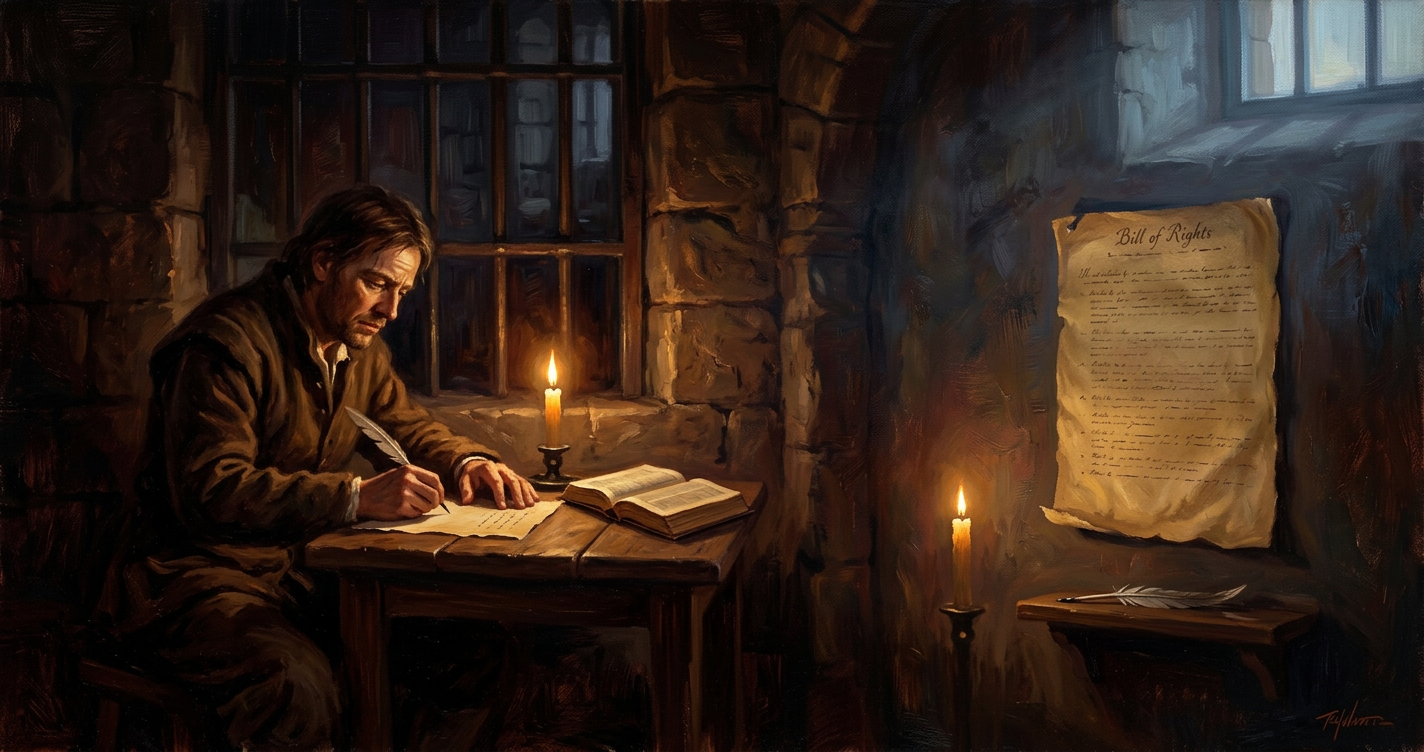
In 1612, an English gentleman named Thomas Helwys returned to London from exile in Amsterdam. He had helped found what is widely regarded as the first Baptist congregation on English soil, at Spitalfields. And he brought with him a small book with a remarkable title: A Short Declaration of the Mistery of Iniquity.
The "mystery of iniquity" is, of course, Paul's phrase from 2 Thessalonians 2:7—the power that was already at work in his day and would develop into the "man of sin." Helwys applied the prophecies of Daniel and Revelation squarely. Rome, he said, was the first beast. But then he did something no one in England dared to do. He turned the prophecy around and pointed it at the Church of England itself.
Helwys’ Argument (Paraphrased)
If the king of England uses his power to force men to be religious—to compel their worship, to appoint lords over their souls, to punish those who dissent—then the church he has built is no true daughter of Christ. It is a daughter of the harlot. It has copied Rome's methods, and in copying them it has become the very image of the beast.
A faithful summary of the argument of A Short Declaration of the Mistery of Iniquity (1612), not a direct quotation.
Think about the courage required to say that in 1612. The Church of England had broken with Rome. It was Protestant. It had the Bible in English—in fact, the King James Version had been published only the year before. And yet Helwys said: you have thrown out the pope, but you have kept the papal principle. You have simply crowned a new head over the conscience.
And then Helwys wrote what historians consider the first plea in the English language for universal liberty of conscience—not merely toleration for his own group, but freedom for everyone:
"For men's religion to God is betwixt God and themselves; the king shall not answer for it, neither may the king be judge between God and man. Let them be heretics, Turks, Jews, or whatsoever, it appertains not to the earthly power to punish them in the least measure."
— Thomas Helwys, A Short Declaration of the Mistery of Iniquity, 1612 (modernized spelling)
Heretics, Turks, Jews, or whatsoever. Do you see how far ahead of his time that was? Helwys did not say the king should protect the true church. He said the king has no jurisdiction over the soul at all. And then, as if to make certain the message was delivered, he inscribed a personal note on the flyleaf of a copy and sent it to King James I:
"Hear, O king, and despise not the counsel of the poor, and let their complaints come before thee. The king is a mortal man, and not God, therefore hath no power over the immortal souls of his subjects, to make laws and ordinances for them, and to set spiritual lords over them."
— Thomas Helwys, handwritten inscription to King James I (modernized spelling)
The Price of Conscience
King James did not respond with argument. Helwys was arrested and thrown into Newgate Prison. He never came out. By 1616 he was dead—one of the first martyrs for the principle that would, some 180 years later, be written into the First Amendment of the United States Constitution.
Ladies and gentlemen, notice the pattern. The man who told the truth about the image of the beast was silenced by the image of the beast. That is exactly what Revelation 13:15 predicts: those who will not worship the image are persecuted.
Part 3: Roger Williams and the Bloudy Tenent
Many who fled England for the New World were fleeing precisely this kind of persecution. The tragedy is that when they arrived, a number of them did the very same thing to others. The Puritans of Massachusetts Bay did not come to establish religious freedom. They came to establish their religion—a "Bible commonwealth" in which only church members could vote, church attendance was compulsory, and the magistrate was charged with punishing violations of the first table of the law.
Enter Roger Williams, a brilliant young minister who arrived in Boston in 1631. Williams made himself dangerous by teaching that the civil magistrate had no authority to punish offenses against the first four commandments—idolatry, blasphemy, Sabbath-breaking. Those were matters between the soul and God. For this, and for challenging the colonists' claim to Native lands, the General Court banished him. In the winter of 1636 he fled into the wilderness and was sheltered by the Narragansett people. There he founded Providence—the first government in the modern world built on full liberty of conscience.
In 1644, Williams published his great work, The Bloudy Tenent of Persecution, for Cause of Conscience. The title says it all: the "tenent" (tenet, doctrine) of persecution is a bloody doctrine. Parliament ordered the book to be burned. Here is what they were trying to burn:
"It is the will and command of God that (since the coming of his Son the Lord Jesus) a permission of the most paganish, Jewish, Turkish, or antichristian consciences and worships, be granted to all men in all nations and countries: and they are only to be fought against with that sword which is only (in soul matters) able to conquer, to wit, the sword of God's Spirit, the Word of God."
— Roger Williams, The Bloudy Tenent of Persecution, 1644
Two swords. The sword of the Spirit belongs to the church. The sword of steel belongs to the state. When the church reaches for the state's sword, it has confessed that it no longer trusts the power of its own.
"And take... the sword of the Spirit, which is the word of God." "For the weapons of our warfare are not carnal, but mighty through God to the pulling down of strong holds."
— Ephesians 6:17; 2 Corinthians 10:4 (KJV)
And it was Roger Williams—not a secularist, but a Bible-believing minister—who gave us the image that Thomas Jefferson would later echo. He wrote of the "hedge or wall of separation between the garden of the church and the wilderness of the world." Notice which side the wall protects. In Williams' mind, when the wall is broken down, it is not the world that is corrupted by the church; it is the church that is overrun by the wilderness.
Why Williams Matters for Revelation 13
Williams understood that the principle of the lamb-like horns is not a secular idea smuggled into Christianity. It is the principle of Christ Himself: "My kingdom is not of this world: if my kingdom were of this world, then would my servants fight" (John 18:36).
A church that fights with the sword of the state has stopped speaking like the Lamb. It has started speaking like the dragon.
Part 4: America in Crimson—Persecution in the Colonies
If you want to understand the persecution roots of America, study the Baptists. Their offense was simple: they would not baptize their babies. They believed baptism belongs to believers who can repent and confess faith (Acts 2:38; 8:36–37). In a colony where infant baptism was the sign of membership in both church and commonwealth, refusing it was treated as sedition.
1644
Massachusetts outlaws Baptists
The General Court passed a law ordering the banishment of anyone who opposed infant baptism.
1651
Obadiah Holmes whipped in Boston
Arrested for holding a Baptist worship service in a private home in Lynn, Holmes received thirty lashes with a three-corded whip. He told the magistrates, “You have struck me as with roses.”
1654
Harvard’s president forced out
Henry Dunster, the first president of Harvard College, was compelled to resign after refusing to have his infant son baptized.
1659–1661
Quakers hanged on Boston Common
Four Quakers, including Mary Dyer, were executed in Massachusetts for returning after banishment.
And it was not only New England. In Virginia, where the Church of England was established by law, Baptist preachers in the 1760s and 1770s were dragged from their pulpits, beaten, and jailed for preaching without a license from the state. Some preached through the bars of their jail windows to crowds gathered outside. The authorities built walls around the jails to stop the people from hearing.
Books like America in Crimson Red have documented this forgotten story in painful detail, and the lesson is always the same. When Christians gained the power of the state, other Christians bled. The persecutors were quoting Scripture. They believed they were defending a Christian nation.
A Sobering Principle
Persecution has almost never been carried out by people who thought they were doing evil. Jesus warned: "The time cometh, that whosoever killeth you will think that he doeth God service" (John 16:2).
The Baptists did not answer the whipping post with a sword. They answered it with a pen and an open Bible. In 1773, the New England Baptist leader Isaac Backus published An Appeal to the Public for Religious Liberty, Against the Oppressions of the Present Day. On its title page he placed Galatians 5:13: "Brethren, ye have been called unto liberty." And inside he drew the line that would one day run straight through the Constitution:
"God has appointed two kinds of government in the world, which are distinct in their nature, and ought never to be confounded together; one of which is called civil, the other ecclesiastical government."
— Isaac Backus, An Appeal to the Public for Religious Liberty, Boston, 1773
Two kinds of government. Distinct in their nature. Never to be confounded together. That is a Baptist preacher, three years before the Declaration of Independence, stating the principle of the First Amendment in plain English.
And the struggle did not end with the Revolution. Look at the Massachusetts Constitution of 1780, largely drafted by John Adams. At first glance it sounds like religious freedom:
"It is the right as well as the duty of all men in society, publicly and at stated seasons, to worship the Supreme Being, the great Creator and Preserver of the universe. And no subject shall be hurt, molested, or restrained, in his person, liberty, or estate, for worshipping God in the manner and season most agreeable to the dictates of his own conscience..."
— Massachusetts Constitution of 1780, Part the First, Article II
But that is not the whole story. Read one article further. Article III empowered the legislature to require the towns to support "public Protestant teachers of piety, religion and morality" by taxation, and to require attendance on their instruction. Freedom of conscience on paper; the church tax in practice. Backus and the Baptists fought it for the rest of their lives, and Massachusetts did not finally disestablish its churches until 1833. Do you see the pattern? A worship "duty" written into civil law, followed by the civil power to fund it. That is the seed of everything Revelation 13 warns about.
Part 5: Madison Saw What Was Going On
In January 1774, a young Virginian named James Madison, fresh out of Princeton, wrote to his friend William Bradford. What he had witnessed in his own county horrified him:
"That diabolical Hell conceived principle of persecution rages among some and to their eternal Infamy the Clergy can furnish their Quota of Imps for such business... There are at this time in the adjacent County not less than 5 or 6 well meaning men in close Gaol for publishing their religious Sentiments which in the main are very orthodox."
— James Madison to William Bradford, January 24, 1774
Notice that phrase: very orthodox. These were not heretics. These were Bible-believing Baptist preachers. Madison saw clearly that the danger was not bad theology. The danger was the union of theology with power. Once the state decides which religion is true, no one's religion is safe—including the religion of the majority, because majorities change.
From Toleration to Free Exercise
Two years later, in 1776, Virginia sat down to write its Declaration of Rights. The author was George Mason, and his original draft of the article on religion was, for its day, generous:
"That as religion or the duty which we owe to our divine and omnipotent Creator, and the manner of discharging it, can be governed only by reason and conviction, not by force or violence: and therefore all men should enjoy the fullest toleration in the exercise of religion."
— George Mason, original draft, Virginia Declaration of Rights, 1776
Beautiful words. But a twenty-five-year-old delegate saw the trap hidden in one of them: toleration. To tolerate is to permit. And whatever a government permits, it may also withdraw. Toleration assumes that the state owns the conscience and graciously lends it back. Madison moved to strike it, and the final text declared that "all men are equally entitled to the free exercise of religion, according to the dictates of conscience." A privilege had become a right. That single word change is the seed of the First Amendment's free exercise clause—and it is why Washington could later say that "it is now no more that toleration is spoken of."
The Most Reasonable-Sounding Bill in Virginia
Now watch how the danger came back. It did not return as a dungeon. It returned as a tax bill, written by one of the great heroes of liberty. Patrick Henry—"give me liberty or give me death"—was a fiery champion of political freedom, and he did oppose religious coercion as he understood it. But in 1784 he proposed a general assessment to support "teachers of the Christian religion." No single church was favoured. Every taxpayer could even direct his money to his own denomination. Read the generosity written into it:
"And be it further enacted, That the money to be raised by virtue of this Act, shall be by the Vestries, Elders, or Directors of each religious society, appropriated to a provision for a Minister or Teacher of the Gospel of their denomination, or the providing places of divine worship, and to none other use whatsoever; except in the denominations of Quakers and Menonists [Mennonites], who may receive what is collected from their members, and place it in their general fund, to be disposed of in a manner which they shall think best calculated to promote their particular mode of worship."
— Patrick Henry, A Bill Establishing a Provision for Teachers of the Christian Religion, 1784
Exemptions for Quakers and Mennonites! Who could object to that? Even the great Richard Henry Lee—the man who moved for independence in the Continental Congress—supported it. He wrote to Madison:
"The declaration of Rights, it seems to me, rather contends against forcing modes of faith and forms of worship, than against compelling contribution for the support of religion in general. I fully agree with the presbyterians, that true freedom embraces the Mahomitan and the Gentoo [Hindu] as well as the Christian religion."
— Richard Henry Lee to James Madison, November 26, 1784
Do you see how subtle it is? Lee was a devout man who believed genuine piety flourished best when it was not coerced. He fully agreed that freedom must embrace the Muslim and the Hindu. And yet he could still reason his way to a law compellingevery citizen to pay for religion "in general." That is how the persecution roots grow back—not through wicked men, but through good men with reasonable-sounding bills. Lee himself would later, in 1787, propose an amendment to the new Constitution that "the rights of Conscience in matters of Religion shall not be violated." Good men change their minds when the argument is made clearly enough.
Madison made it. He answered with his Memorial and Remonstrance Against Religious Assessments, and its opening lines are a summons to every citizen:
"And conceiving that the same if finally armed with the sanctions of a law, will be a dangerous abuse of power, are bound as faithful members of a free State to remonstrate against it, and to declare the reasons by which we are determined. We remonstrate against the said Bill..."
— James Madison, Memorial and Remonstrance, 1785, preamble
Bound, he says. Not merely permitted to object—bound, as faithful members of a free State. Liberty is not a spectator sport. And then comes one of the most prophetic sentences ever written on this subject:
"Who does not see that the same authority which can establish Christianity, in exclusion of all other Religions, may establish with the same ease any particular sect of Christians, in exclusion of all other Sects?"
— James Madison, Memorial and Remonstrance, 1785
Now listen carefully, because Madison—the man history calls the "Father of the Constitution"—did not oppose the bill because he despised Christianity. He opposed it for the sake of Christianity. He begins with the conscience itself:
"The Religion then of every man must be left to the conviction and conscience of every man; and it is the right of every man to exercise it as these may dictate."
— James Madison, Memorial and Remonstrance, 1785, §1
And then he makes an argument that ought to stop every Christian nationalist in his tracks. He says that to claim Christianity needs the support of the state is to contradict Christianity itself:
"Because the establishment proposed by the Bill is not requisite for the support of the Christian Religion. To say that it is, is a contradiction to the Christian Religion itself, for every page of it disavows a dependence on the powers of this world."
— James Madison, Memorial and Remonstrance, 1785, §6
Every page of it disavows a dependence on the powers of this world. Madison had read his Bible. He knew that the Christianity of the New Testament conquered the Roman Empire while Rome was persecuting it, not sponsoring it. And he knew what happened after Rome began to sponsor it:
"During almost fifteen centuries has the legal establishment of Christianity been on trial. What have been its fruits? More or less in all places, pride and indolence in the Clergy, ignorance and servility in the laity, in both, superstition, bigotry and persecution."
— James Madison, Memorial and Remonstrance, 1785, §7
Fifteen centuries. Count them back from 1785 and you arrive at the age of Constantine, when church and empire first joined hands. Madison was describing, in the language of a statesman, the very period the prophets described in the language of symbol: the rise of the first beast.
Madison warned that it is proper to take alarm "at the first experiment on our liberties." The Baptists of Virginia flooded the legislature with petitions against the assessment. The bill was defeated, and in 1786 Virginia passed Jefferson's Statute for Establishing Religious Freedom. Five years later, with Baptist pressure once again decisive, Madison shepherded into the Constitution the words that stand as the first liberty of the Bill of Rights:
"Congress shall make no law respecting an establishment of religion, or prohibiting the free exercise thereof..."
— First Amendment, United States Constitution, 1791
Two clauses. No establishment. Free exercise. Two horns—like a lamb. Do you see it? The First Amendment is the lamb-like character of Revelation 13:11 written into law. It is the harvest of Thomas Helwys' prison cell, Roger Williams' banishment, and Obadiah Holmes' bleeding back.
Thomas Jefferson, who wrote the Virginia Statute, understood what it meant. The statute declared that no person "shall be compelled to frequent or support any religious worship, place, or ministry whatsoever," nor "suffer on account of his religious opinions or belief." When Jefferson wrote his own epitaph, he chose three things to be remembered for. He left out the presidency. Carved on the stone at Monticello are these words: Author of the Declaration of American Independence, of the Statute of Virginia for Religious Freedom, and Father of the University of Virginia.
The Founders Spoke With One Voice
Madison was not a lone voice. Years before the Revolution, the patriots of Boston were already saying it. In 1772 Samuel Adams drafted The Rights of the Colonists for the Boston town meeting:
"As neither reason requires nor religion permits the contrary, every man living in or out of a state of civil society has a right peaceably and quietly to worship God according to the dictates of his conscience."
— Samuel Adams, The Rights of the Colonists, 1772
And Adams explained exactly where the danger lay. He followed John Locke in arguing that toleration should extend to all whose doctrines are not subversive of society—and he named the one system he believed was:
"In regard to religion, mutual toleration in the different professions thereof is what all good and candid minds in all ages have ever practised... The only sects which he thinks ought to be, and which by all wise laws are excluded from such toleration, are those who teach doctrines subversive of the civil government under which they live. The Roman Catholics or Papists are excluded by reason of such doctrines as these, that princes excommunicated may be deposed, and those that they call heretics may be destroyed without mercy; besides their recognizing the Pope in so absolute a manner, in subversion of government, by introducing, as far as possible into the states under whose protection they enjoy life, liberty, and property, that solecism in politics, imperium in imperio, leading directly to the worst anarchy and confusion, civil discord, war, and bloodshed."
— Samuel Adams, The Rights of the Colonists, 1772
Let us be careful and honest here. Adams still spoke the older language of toleration, and his exclusion went further than Madison and the First Amendment would go—the Constitution protects the Catholic neighbour's conscience exactly as it protects the Baptist's. But notice what Adams was objecting to. Not to a person's prayers or beliefs. He objected to a political claim: that a church may depose rulers and destroy heretics. A solecismis something that deviates from the proper order—a blunder in grammar. Imperium in imperiomeans "a government within a government." Adams called a church that wields civil power a grammatical error in the sentence of a free nation. That is the union of church and state described in Revelation 13, seen through the eyes of a Boston patriot.
That same year, on the anniversary of the Boston Massacre, the physician Dr. Joseph Warren—who would fall three years later at Breed's Hill—stood before the town and used language that could have come straight from Thomas Helwys' prison cell:
"The tools of power in every age have racked their inventions to justify the FEW in sporting with the happiness of the MANY; and, having found their sophistry too weak to hold mankind in bondage, have impiously dared to force religion, the daughter of the king of Heaven, to become a prostitute in the service of Hell. They taught that princes, honoured with the name of christian, might bid defiance to the founder of their faith, might pillage pagan countries and deluge them with blood, only because they boasted themselves to be the disciples of that teacher who strictly charged his followers to do to others as they would that others should do unto them."
— Dr. Joseph Warren, Oration, Boston, March 5, 1772
Hear the echo. Helwys told a king that a forced religion made him the daughter of the harlot. Warren told Boston that forced religion turns the daughter of the King of Heaven into a prostitute in the service of Hell. One hundred and sixty years apart, the same truth: when the church takes the sword of the state, the bride becomes the harlot of Revelation 17.
Two years later, a nineteen-year-old student named Alexander Hamilton wrote A Full Vindication of the Measures of the Congress. He warned that civil and religious freedom cannot be separated:
"But being ruined by taxes is not the worst you have to fear. What security would you have for your lives? How can any of you be sure you would have the free enjoyment of your religion long? would you put your religion in the power of any set of men living? Remember civil and religious liberty always go together, if the foundation of the one be sapped, the other will fall of course."
— Alexander Hamilton, A Full Vindication of the Measures of the Congress, 1774
And what alarmed him most was a law that had just set up an established church on America's northern border:
"The affair of Canada, if possible, is still worse. The English laws have been superceded by the French laws. The Romish faith is made the established religion of the land, and his Majesty is placed at the head of it. The free exercise of the protestant faith depends upon the pleasure of the Governor and Council."
— Alexander Hamilton, A Full Vindication of the Measures of the Congress, 1774
"Depends upon the pleasure of the Governor." There it is again—toleration instead of right. Whatever faith a government establishes, every other faith survives only at its pleasure. Hamilton went on to champion a strong federal government, but one that would not interfere in matters of conscience, because he saw that freedom of religion holds a diverse people together rather than tearing them apart.
When the Constitution came before the Connecticut ratifying convention in 1788, Oliver Wolcott—a signer of the Declaration of Independence—expressed the confidence of his generation. Wolcott's own state still kept a tax-supported church, and yet even he could say of the nation:
"Knowledge and liberty are so prevalent in this country, that I do not believe that the United States would ever be disposed to establish one religious sect, and lay all others under legal disabilities."
— Oliver Wolcott, Connecticut Ratifying Convention, January 9, 1788
Would ever be disposed.Wolcott believed it could never happen here. The prophecy of Revelation 13:11 says it will. The only thing that stands between Wolcott's confidence and John's warning is whether "knowledge and liberty" remain prevalent among the people. That is why the knowledge in this article matters.
Then listen to the first president, writing in 1790 to the Hebrew congregation at Newport, Rhode Island—the colony Roger Williams founded:
"It is now no more that toleration is spoken of as if it were the indulgence of one class of people that another enjoyed the exercise of their inherent natural rights, for, happily, the Government of the United States, which gives to bigotry no sanction, to persecution no assistance, requires only that they who live under its protection should demean themselves as good citizens in giving it on all occasions their effectual support... while every one shall sit in safety under his own vine and fig-tree, and there shall be none to make him afraid."
— George Washington, Letter to the Touro Synagogue, Newport, August 1790
"Under his own vine and fig-tree"—Washington was quoting the prophet Micah (4:4). No longer "toleration," as though liberty were a favor granted by the majority to a minority. A natural right, belonging to every person. And notice how Washington kept his own faith. Mount Vernon's historians record that he took communion before the Revolution but not afterward. When a Philadelphia minister rebuked him from the pulpit for leaving before the communion service, Washington did not reach for the power of his office. He simply stopped attending on communion Sundays. Whatever one makes of that, it was a matter between Washington and his God, and he treated it that way.
Then hear Benjamin Franklin, writing to the English minister Richard Price in 1780. Franklin was no friend of a strict wall like Jefferson, but he believed deeply in the right of every person to practice their faith without government coercion, and he put the whole matter in one sentence:
"When a Religion is good, I conceive that it will support itself; and when it cannot support itself, and God does not take care to support, so that its Professors are oblig'd to call for the help of the Civil Power, 'tis a Sign, I apprehend, of its being a bad one."
— Benjamin Franklin to Richard Price, October 9, 1780
Read that again, slowly, and then think about every movement today that asks the government to prop up the faith. And then the nation said it to the world. In 1796, the United States signed a treaty with Tripoli. It was ratified by the Senate without a single dissenting vote and signed by President John Adams:
"As the Government of the United States of America is not, in any sense, founded on the Christian religion; as it has in itself no character of enmity against the laws, religion, or tranquillity, of Mussulmen; and as the said States never entered into any war or act of hostility against any Mahometan nation, it is declared by the parties that no pretext arising from religious opinions shall ever produce an interruption of the harmony existing between the two countries."
— Treaty of Peace and Friendship with Tripoli, Article 11, signed November 4, 1796; ratified 1797
Not founded on the Christian religion—by men who were overwhelmingly Christian. That is not a contradiction. It is the whole point. They were a Christian people who refused to build a Christian government, because they had seen what Christian governments did to Christians.
Madison Never Changed His Mind
Decades later, as an elder statesman looking back on what the experiment had produced, Madison wrote that the results had proven the founders right:
"The number, the industry, and the morality of the Priesthood, & the devotion of the people have been manifestly increased by the total separation of the Church from the State."
— James Madison to Robert Walsh, March 2, 1819
Did you catch it? Total separation. And the fruit was not a weaker church but a stronger one. Three years later he wrote to Edward Livingston:
"We are teaching the world the great truth that Govts do better without Kings & Nobles than with them. The merit will be doubled by the other lesson that Religion flourishes in greater purity, without than with the aid of Govt.... And in a Government of opinion, like ours, the only effectual guard must be found in the soundness & stability of the general opinion on the subject. Every new & successful example therefore of a perfect separation between ecclesiastical & Civil matters is of importance. And I have no doubt that every new example will succeed, as every past one has done, in shewing that Religion & Govt. will both exist in greater purity, the less they are mixed together."
— James Madison to Edward Livingston, July 10, 1822
"The only effectual guard," Madison says, is public opinion. Not a court. Not a parchment. The people themselves must understand why the wall matters. That is why this article exists. And near the end of his life, writing to the Rev. Jasper Adams, a minister who had argued that Christianity should have the support of government, Madison named the system he was guarding against:
"In the Papal System, Government and Religion are in a manner consolidated, & that is found to be the worst of Govts. In most of the Govts. of the old world, the legal establishment of a particular religion and without or with very little toleration of others makes a part of the Political and Civil organization and there are few of the most enlightened judges who will maintain that the system has been favorable either to Religion or to Govt."
— James Madison to the Rev. Jasper Adams, 1832–1833
The Papal System. The Father of the Constitution named it outright. He knew that church and state consolidated into one power was not a new idea waiting to be tried. It had been tried for more than a thousand years, and he called it "the worst of Govts." Hold that thought, because prophecy will bring us right back to it.
The Father of the Constitution on Religion
Religion flourishes in greater purity without the aid of government. That is not the voice of a man trying to drive God out of the nation. It is the voice of a man who had watched Bible-believing preachers sit in jail, and who understood that the church is never purer, never stronger, and never more like her Lord than when she stands on the Word alone.
Part 6: “My Kingdom Is Not of This World”
Now we come to the heart of the matter, and I want us to take our time here, because everything else rests on it. Why did the persecuted believers insist that Caesar has no jurisdiction over the soul? Because they understood what Jesus came to do.
"And she shall bring forth a son, and thou shalt call his name JESUS: for he shall save his people from their sins."
— Matthew 1:21 (KJV)
Notice what the angel did notsay. He did not say, "He shall save his people from the Romans." That is exactly what many in Israel wanted. They wanted a Messiah who would take the sword, drive out Caesar, and set up a righteous nation in Jerusalem. On one occasion they tried to take Him by force and make Him king—and He withdrew from them (John 6:15). When Peter drew a sword in the garden, Jesus told him to put it away (Matthew 26:52). And when Pilate asked Him directly whether He was a king, He gave the answer that is the foundation stone of religious liberty:
"Jesus answered, My kingdom is not of this world: if my kingdom were of this world, then would my servants fight, that I should not be delivered to the Jews: but now is my kingdom not from hence."
— John 18:36 (KJV)
Christ's ultimate purpose was never to seize the governments of this earth. It was to save sinners and to establish a heavenly, eternal kingdom—"a kingdom which cannot be moved" (Hebrews 12:28), a city "whose builder and maker is God" (Hebrews 11:10). That kingdom is entered not by legislation, but by new birth: "Except a man be born again, he cannot see the kingdom of God" (John 3:3).
Legislation cannot save a soul.
A law can compel a man to sit in a pew. It can never make him love the One the pew was built to honor.
Think about it. The state can change behavior; only God can change a heart. You can pass a law that forces a man to rest on a certain day, to bow at a certain time, to recite a certain prayer. And what have you produced? Not a Christian. You have produced a hypocrite—or a martyr. That is all compulsion has ever produced, in fifteen centuries of trying.
Where, then, does God write His law? Not on the statute books of a nation, but on the tablets of the heart:
"For this is the covenant that I will make with the house of Israel after those days, saith the Lord; I will put my laws into their mind, and write them in their hearts: and I will be to them a God, and they shall be to me a people."
— Hebrews 8:10 (KJV)
That is the new covenant. God Himself does the writing, and He writes on the inside. A legislature can carve the Ten Commandments in granite on a courthouse lawn, but it cannot write a single one of them on a human heart. Only the Spirit of God can do that.
So what does bring a sinner to God? Scripture answers with one voice:
"Or despisest thou the riches of his goodness and forbearance and longsuffering; not knowing that the goodness of God leadeth thee to repentance?"
— Romans 2:4 (KJV)
"And I, if I be lifted up from the earth, will draw all men unto me."
— John 12:32 (KJV)
"We love him, because he first loved us."
— 1 John 4:19 (KJV)
It is the goodness of God—not the power of the magistrate—that leads to repentance. It is the cross—not the courthouse—that draws all men. At Calvary, God revealed His love and His mercy in a way that no law ever could. There, the King of the universe did not force a single soul. He gave Himself. And ever since, men and women have come to Him not because they were made to, but because they wantedto—because they beheld a love so great that it broke their hearts and won them back.
Why the Wall Is a Gospel Issue
God could compel every knee this very moment. He does not—because He is not seeking servile obedience; He is seeking love. And love, by its very nature, must be freely given. The moment worship is forced, it ceases to be worship.
This is why the wall of separation between church and state is not a secular idea opposed to the gospel. It is the gospel's own method written into civil law. A government that refuses to compel the conscience is simply refusing to do what God Himself refuses to do.
So if someone says, "America is a Christian nation," let us reply: then let it behave like Christ. A truly Christian nation will not compel the conscience, because Christ never compelled it. A truly Christian nation will protect the liberty of the unbeliever as carefully as the liberty of the believer, because Christ "came not to destroy men's lives, but to save them" (Luke 9:56). And a truly Christian nation will leave the salvation of souls where it has always belonged—in the hands of a loving God, working through the preaching of His Word and the drawing of His Spirit.
Part 7: The Two Tables of the Law
Jesus Himself drew the line. When His enemies tried to trap Him with a question about taxes, He asked for a coin:
"And he saith unto them, Whose is this image and superscription? They say unto him, Caesar's. Then saith he unto them, Render therefore unto Caesar the things which are Caesar's; and unto God the things that are God's."
— Matthew 22:20–21 (KJV)
The coin bore Caesar's image, so it belonged to Caesar. But what bears the image of God? You do. "God created man in his own image" (Genesis 1:27). Caesar may have your taxes. He may not have your soul. Two jurisdictions, set side by side by the Lord Jesus Christ—exactly what Backus called "two kinds of government."
Now we must go deeper, because here lies the real crux of the issue. God wrote His law on two tables of stone (Exodus 31:18). Jesus summarized them for us:
"Thou shalt love the Lord thy God with all thy heart, and with all thy soul, and with all thy mind. This is the first and great commandment. And the second is like unto it, Thou shalt love thy neighbour as thyself. On these two commandments hang all the law and the prophets."
— Matthew 22:37–40 (KJV)
The First Table
Commandments 1–4 • Our duty to God
No other gods. No graven images. Not taking His name in vain. Remembering the Sabbath. These govern worship—and worship can only be rendered freely, from the heart. God alone is judge here.
The Second Table
Commandments 5–10 • Our duty to man
Murder, theft, adultery, false witness—these injure our neighbour. Here civil government has a legitimate role: "he is the minister of God to thee for good" (Romans 13:4).
Roger Williams built his entire case on this distinction. The Puritan magistrates claimed a duty to enforce both tables. Williams said: no. The civil sword may protect my neighbour from theft and violence, but it has no jurisdiction over whom I worship, how I worship, or when I worship.
A Reflection From the Supreme Court Building
On the east pediment of the United States Supreme Court building, Moses is carved holding the two tablets of the Law. Some who have studied the imagery have observed that the first table appears lowered and set against him, while the second is presented outward. Whether or not the sculptor intended it, the image makes a profound point: the civil courts of this nation were never meant to enforce the first table. Duties to God belong to God. Duties to our neighbour may be protected by the state.
Now here is why this matters prophetically. Look at what the image of the beast enforces in Revelation 13: worship. "Cause that as many as would not worshipthe image..." The final crisis is not about theft or murder. It is a first-table issue. And in Revelation 14, God's final warning message calls the world back to worship the Creator—in language drawn directly from the fourth commandment:
"Fear God, and give glory to him; for the hour of his judgment is come: and worship him that made heaven, and earth, and the sea, and the fountains of waters."
— Revelation 14:7 (KJV); compare Exodus 20:11
Now set that beside the commandment it quotes:
"Remember the sabbath day, to keep it holy. Six days shalt thou labour, and do all thy work: but the seventh day is the sabbath of the LORD thy God: in it thou shalt not do any work, thou, nor thy son, nor thy daughter, thy manservant, nor thy maidservant, nor thy cattle, nor thy stranger that is within thy gates: for in six days the LORD made heaven and earth, the sea, and all that in them is, and rested the seventh day: wherefore the LORD blessed the sabbath day, and hallowed it."
— Exodus 20:8–11 (KJV)
Every official seal in history carries three things: a name, a title, and a territory. Look closely at this commandment and you will find all three. The name: the LORD thy God. The title: the One who made—the Creator. The territory: heaven and earth, the sea, and all that in them is. Of the ten, this is the only commandment that tells you who the Lawgiver is and what He rules. It is the seal of the law. And it is exactly this commandment that the last message of Revelation 14 calls the world back to, in the very moment the image of the beast is demanding worship of its own. No civil court may enforce it, and no civil court may forbid it. It belongs to God alone.
The battle at the end is over the first table of the law—and specifically over which day and whose authority. Daniel saw it centuries in advance, describing the little horn power that would rise out of Rome:
"And he shall speak great words against the most High, and shall wear out the saints of the most High, and think to change times and laws: and they shall be given into his hand until a time and times and the dividing of time."
— Daniel 7:25 (KJV)
Think to change times and laws. The only commandment in the Decalogue that deals with time is the fourth. And notice the companion phrase: "wear out the saints." Wherever a power presumes to change God's law, it eventually needs the civil sword to enforce the change. The moment civil government begins legislating the first table, it has stepped onto the ground of Daniel 7 and Revelation 13.
Part 8: Is “Separation of Church and State” Weaponized?
On January 1, 1802, President Thomas Jefferson replied to a letter from the Danbury Baptist Association of Connecticut—a state which still had an established church. The Baptists were suffering as a minority and asked for his support. Here is what Jefferson wrote:
"Believing with you that religion is a matter which lies solely between man & his god, that he owes account to none other for his faith or his worship, that the legitimate powers of government reach actions only, & not opinions, I contemplate with sovereign reverence that act of the whole American people which declared that their legislature should 'make no law respecting an establishment of religion, or prohibiting the free exercise thereof,' thus building a wall of separation between Church & State."
— Thomas Jefferson to the Danbury Baptist Association, January 1, 1802
"Believing with you." Jefferson was agreeing with the Baptists. The wall was their idea before it was his phrase. And look at the boundary he draws: government reaches actions only, not opinions. That is the two tables of the law again. The state may restrain a man who harms his neighbour; it has no jurisdiction over what he believes about his God.
Now listen to what is being said in our own day. In April 2026, the chairman of a national Religious Liberty Commission declared:
"It is time to set the record straight: there is no such thing as 'separation of church and state' in the Constitution. For too long, the anti-God left has used this phrase to suppress people of religion in our country."
— Dan Patrick, Lieutenant Governor of Texas, Chairman, Religious Liberty Commission, April 13, 2026
Part of that statement is true. The phraseis not in the Constitution. Neither is the phrase "separation of powers," yet no one doubts the principle is there. The principle of separation is written into the very first words of the Bill of Rights: "Congress shall make no law respecting an establishment of religion." And the men who wrote and ratified those words told us, in their own hand, what they meant. Madison called it "the total separation of the Church from the State" and "a perfect separation between ecclesiastical & Civil matters."
Some scholars argue that the founders wanted no real separation at all, and that Jefferson himself did not live as though there were a wall. It is true that the founders differed in degree, and that early America was full of public religion. But public religion freely expressed by the people is not the same thing as religion enforced by the government. Washington, Franklin, Madison, the Senate that ratified the Treaty of Tripoli, and the Baptists who suffered under the colonial establishments were all agreed on that one point: the civil power may not compel the conscience.
Today many sincere Christians have been told that this phrase is a weapon—that it is used to remove prayer, Bibles, and Christian witness from public life. And it is true that the phrase has at times been misused to suppress the free exercise of individual believers. A student praying, a citizen speaking of their faith, a church preaching its convictions—these are not establishments of religion. They are exactly what the free exercise clause protects.
But be careful. Because there is another weaponization going on, and it is far more dangerous. It is the effort to convince Christians that the wall itself is the enemy—that separation is a secular myth, and that the path to national righteousness runs through legislation of religion. Ask yourself: who benefits if the wall comes down?
Misusing the wall
Treating any public expression of faith by a private citizen as an "establishment." This attacks the free exercise horn.
Tearing down the wall
Using the power of government to promote, fund, or enforce religious observance. This attacks the no establishment horn.
So let us be absolutely clear about where the wall came from. It was not invented by a modern court. It was raised, stone by stone, by our forefathers:
The Wall Our Forefathers Built
- Roger Williams (1644):a "hedge or wall of separation between the garden of the church and the wilderness of the world."
- Isaac Backus (1773), the Baptist leader of New England, in An Appeal to the Public for Religious Liberty: "God has appointed two kinds of government in the world, which are distinct in their nature, and ought never to be confounded together."
- James Madison (1785):the Christian religion "disavows a dependence on the powers of this world."
- The First Amendment (1791):"Congress shall make no law respecting an establishment of religion, or prohibiting the free exercise thereof."
- George Washington (1790),to the Touro Synagogue: a government "which gives to bigotry no sanction, to persecution no assistance."
- The Treaty of Tripoli (1796–1797):"the Government of the United States of America is not, in any sense, founded on the Christian religion."
- Thomas Jefferson (1802),to the Danbury Baptists: "a wall of separation between Church & State."
- James Madison (1819):the devotion of the people "manifestly increased by the total separation of the Church from the State."
- James Madison (1822):"Religion flourishes in greater purity, without than with the aid of Govt."
A lamb needs both horns. Break either one, and the lamb-like character is gone. The wall was built by Baptists to protect the church from the state. Remember Roger Williams: the wall guards the garden.
Part 9: The Image of the Beast and Christian Nationalism
We now come to the present. Around the world and in our own nation, there are growing calls for a Christian nationalism—the idea that the nation should officially identify with Christianity and that its laws should reflect and enforce Christian morality, including matters of worship. Many who embrace these ideas are godly people who love their country and are alarmed by its decline. We must speak to them with kindness.
But we must also speak clearly, as Helwys did. The desire is noble; the method is Rome's. The moment Protestants reach for the civil sword to enforce religious observance, they have made an image to the beast. They have copied the very system their spiritual forefathers died resisting.
Do you want to know who first insisted that separation of church and state is a myth? It was not a modern American. Listen to Rome, speaking officially in 1906:
"That the State must be separated from the Church is a thesis absolutely false, a most pernicious error. Based, as it is, on the principle that the State must not recognize any religious cult, it is in the first place guilty of a great injustice to God."
— Pope Pius X, Vehementer Nos, February 11, 1906
Now put that beside what you hear today: "There is no such thing as separation of church and state." Whose voice does that echo? Not Madison's. Not Backus'. Not Roger Williams'. It echoes the papacy, which has always taught that the state owes its power to the support of the church. When Protestants begin to say what Rome has always said, the image is already taking shape.
This is not a new interpretation. The early American Baptists saw it themselves. In 1791, the same year the First Amendment was ratified, Isaac Backus applied Revelation 13 directly to the Protestant powers of his own day:
"And though he soon after received a deadly wound, by the sword of the Spirit, yet that deadly wound was healed. Rev. xiii. 1–5, 11–18. For the Protestant beast hath carried blood and slavery round the world, in galleys and gallant ships, as far as the first beast ever did... Yet the spiritual tyranny, which came from Rome and England, is continued in several of the United States of America."
— Isaac Backus, The Infinite Importance of the Obedience of Faith, and of a Separation from the World, 1791
The Protestant beast. A Baptist who had been jailed and taxed by Protestant authorities understood that persecution does not become holy when it changes denominations. The spiritual tyranny "which came from Rome and England" had followed the colonists across the ocean. And prophecy tells us where it leads:
"And he exerciseth all the power of the first beast before him, and causeth the earth and them which dwell therein to worship the first beast, whose deadly wound was healed."
— Revelation 13:12 (KJV)
Notice: the image does not lead people to Christ. It leads them to worship the first beast. A Protestant America that forgets its freedom roots will find itself restoring the authority of the very power it once protested against. The daughter will come home to the mother (Revelation 17:5).
The Pattern of History
- Moral crisis creates fear and a longing for national righteousness.
- Religious leaders seek the help of the civil power to enforce their convictions.
- Laws are passed touching worship—always presented as being for the public good.
- Those who dissent for conscience' sake are labeled as troublemakers.
- Penalties escalate: fines, exclusion, prison—"no man might buy or sell."
It happened to Helwys. It happened to Holmes. It happened to the Baptists of Virginia. Prophecy says it will happen again.
Which Roots Will We Choose?
So we return to the question. When people say, "Let's get back to our roots," we must ask: which roots? The roots of Massachusetts Bay, with its whipping post and its gallows? Or the roots of Providence, with its open door for every conscience? The roots of the established church of Virginia, jailing Baptist preachers? Or the roots of Madison's Remonstrance and the First Amendment?
The case for the First Amendment is ultimately the case for the character of Christ. God Himself does not force the conscience. He placed the tree in the garden. He says, "Behold, I stand at the door, and knock" (Revelation 3:20). He knocks; He does not break the door down. Love cannot be compelled, and worship that is compelled is not worship at all.
No legislature ever saved a soul. No court ever wrote the law of God upon a human heart. That work belongs to the One who said, "My kingdom is not of this world," and who proved His love at the cross. Our forefathers understood this. That is why they built the wall—not to keep God out of America, but to keep the hands of Caesar off the altar of the heart.
"Choose you this day whom ye will serve... but as for me and my house, we will serve the LORD."
— Joshua 24:15 (KJV)
Thomas Helwys died in Newgate so that you could make that choice freely. Roger Williams walked into a winter wilderness so that you could make that choice freely. Obadiah Holmes bled so that you could make it freely. Let us not be the generation that trades their freedom for a counterfeit of the kingdom of God.
"The king is a mortal man, and not God, therefore hath no power over the immortal souls of his subjects."
Stand for the freedom roots. Stand for the Lamb.
Questions People Are Asking
Whether you came here looking for the case for a Christian nation, or you have given up on this nation having any shared values at all, these are the questions that matter most. Each one is answered plainly, from the historical record and from Scripture.
Is America a Christian nation?
America was settled largely by Christians, and biblical ideas shaped its people. But the Constitution deliberately established no national church. The founders had watched Christian colonies jail, whip, and banish other Christians, so they chose a republic in which no government may legislate faith. A nation of free Christians is a very different thing from a Christian government. The first is the fruit of the gospel. The second is what the persecuted Baptists fled.
What did James Madison say about religion and government?
Madison said the religion of every man “must be left to the conviction and conscience of every man” (Memorial and Remonstrance, 1785). In 1819 he observed that the devotion of the people had “been manifestly increased by the total separation of the Church from the State” (to Robert Walsh). In 1822 he wrote that “Religion flourishes in greater purity, without than with the aid of Govt.” and that “Religion & Govt. will both exist in greater purity, the less they are mixed together” (to Edward Livingston). In 1833 he warned that “in the Papal System, Government and Religion are in a manner consolidated, & that is found to be the worst of Govts.” (to Jasper Adams).
Is separation of church and state in the Constitution?
The exact phrase is not in the Constitution, just as the phrase “separation of powers” is not. The principle is. The First Amendment begins, “Congress shall make no law respecting an establishment of religion, or prohibiting the free exercise thereof.” The men who wrote and ratified it explained what it meant. Jefferson said it built “a wall of separation between Church & State” (1802). Madison, who drafted it, called it “the total separation of the Church from the State” (1819) and “a perfect separation between ecclesiastical & Civil matters” (1822). The modern claim that separation is a myth echoes Pope Pius X, who called it “a thesis absolutely false, a most pernicious error” (Vehementer Nos, 1906).
Was the United States founded on the Christian religion?
The Treaty of Tripoli, ratified unanimously by the Senate and signed by President John Adams in 1797, states that “the Government of the United States of America is not, in any sense, founded on the Christian religion.” Most of the founders were Christians, but they deliberately built a government that would not establish or enforce any religion. George Washington wrote in 1790 that the United States “gives to bigotry no sanction, to persecution no assistance.” Benjamin Franklin wrote in 1780 that when a religion must “call for the help of the Civil Power, ’tis a Sign, I apprehend, of its being a bad one.”
What is Christian nationalism, and why does this article warn against it?
The term is used in different ways. Here it means the effort to use civil law to establish or enforce the Christian religion, or one version of it, as a nation’s official faith. The article does not argue that Christians should stay out of public life. It argues that when government enforces worship, it copies the method of the first beast of Revelation 13. That is the same model Thomas Helwys, Roger Williams, and the colonial Baptists suffered under.
Where does the phrase “separation of church and state” come from?
The phrase is not in the Constitution, but the principle is. Roger Williams wrote in 1644 of a “hedge or wall of separation between the garden of the church and the wilderness of the world.” In 1802 Thomas Jefferson told the Danbury Baptists that the First Amendment built “a wall of separation between Church & State.” Williams’ wall was meant to protect the church, not to shut God out of public life.
Does separation of church and state mean keeping God out of public life?
No. The First Amendment forbids government from establishing religion and from prohibiting its free exercise. Citizens remain free to pray, preach, publish, and vote their conscience. What the wall forbids is the state taking up the sword of religion, meaning taxing people for a church, compelling worship, or punishing dissent. Using the phrase to silence believers distorts it. Using power to compel belief breaks it.
What does Revelation 13:11 mean?
Revelation 13:11 describes a second beast rising “out of the earth” with “two horns like a lamb” that “spake as a dragon.” Historic Protestant interpreters have identified it as the United States. It rose in a sparsely populated new land around the time the first beast was wounded, and its two lamb-like horns were civil and religious liberty. Speaking “as a dragon” means that one day it will legislate worship, causing people to honor the first beast and forming an “image” of it (Revelation 13:12–17).
What is the image of the beast?
An image is a copy. If the first beast was a union of church and state that used civil power to enforce religious doctrine, then the image of the beast is a copy of that system formed in the land that once rejected it. As early as 1612, Thomas Helwys argued that any king who forces people to be religious has built a daughter of the harlot and an image of the beast. He died in Newgate Prison for saying so.
What did Jesus mean when He said, “My kingdom is not of this world”?
Before Pilate, Jesus said, “My kingdom is not of this world: if my kingdom were of this world, then would my servants fight” (John 18:36). His purpose was to save His people from their sins (Matthew 1:21) and to establish an eternal, heavenly kingdom. That kingdom advances by persuasion and love, not by force: “I, if I be lifted up from the earth, will draw all men unto me” (John 12:32). No law can produce the new birth. Only the goodness of God leads to repentance (Romans 2:4).
I am not religious. Why should religious liberty matter to me?
Because the wall protects you too. In 1612 Thomas Helwys pleaded for liberty for “heretics, Turks, Jews, or whatsoever,” not only for his own church. The same freedom that lets a believer worship lets you decline to. If you feel that shared values are being thrown away, the answer is not to give up on the people around you. We the people are still worth fighting for, and every person with breath in their lungs is responsible for their own conscience. No king, court, or crowd can carry that responsibility for you, or take it from you.
Who was Thomas Helwys?
Thomas Helwys (c. 1575–c. 1616) was an English Baptist leader who founded one of the first Baptist congregations in England. In 1612 he published A Short Declaration of the Mistery of Iniquity, one of the first books in English to plead for universal liberty of conscience. He inscribed a copy to King James I, saying “the king is a mortal man, and not God,” and he was imprisoned in Newgate, where he died.
Sources for Further Study
- Thomas Helwys, A Short Declaration of the Mistery of Iniquity (1612).
- Roger Williams, The Bloudy Tenent of Persecution, for Cause of Conscience (1644).
- James Madison, letter to William Bradford (January 24, 1774).
- James Madison, Memorial and Remonstrance Against Religious Assessments (1785).
- James Madison, letter to Robert Walsh (March 2, 1819).
- James Madison, letter to Edward Livingston (July 10, 1822).
- James Madison, letter to the Rev. Jasper Adams (1832–1833).
- Isaac Backus, An Appeal to the Public for Religious Liberty (Boston, 1773).
- Isaac Backus, The Infinite Importance of the Obedience of Faith, and of a Separation from the World (1791).
- Constitution of the Commonwealth of Massachusetts (1780), Part the First, Articles II–III.
- Samuel Adams, The Rights of the Colonists (Boston, 1772).
- Dr. Joseph Warren, Oration delivered at Boston, March 5, 1772.
- Alexander Hamilton, A Full Vindication of the Measures of the Congress (1774).
- George Mason, original draft of the Virginia Declaration of Rights (1776), Article 16.
- Patrick Henry, A Bill Establishing a Provision for Teachers of the Christian Religion (1784).
- Richard Henry Lee, letter to James Madison (November 26, 1784).
- Richard Henry Lee, proposed amendments to the Constitution (1787).
- Oliver Wolcott, speech in the Connecticut Ratifying Convention (January 9, 1788).
- Benjamin Franklin, letter to Richard Price (October 9, 1780).
- Virginia Statute for Religious Freedom (drafted 1777, passed 1786).
- George Washington, letter to the Hebrew Congregation in Newport, Rhode Island (August 1790).
- Mount Vernon, "George Washington and Religion".
- Treaty of Peace and Friendship between the United States and Tripoli, Article 11 (1796–1797).
- Thomas Jefferson, letter to the Danbury Baptist Association (January 1, 1802).
- Pope Pius X, Vehementer Nos (February 11, 1906).
- America in Crimson Red — on the persecution of Baptists in the American colonies.
- The Holy Bible, King James Version: Revelation 13–14; Daniel 7:25; Micah 4:4; Matthew 1:21; Matthew 22; Hebrews 8:10; John 3:3; John 12:32; John 18:36; Romans 2:4; 1 John 4:19.